
Done For You Linkedin Services: Is It Worth It For Saas Companies?
You are probably asking this because you’re exhausted.
Maybe you’re a founder who knows LinkedIn matters, you see competitors getting inbound leads and DM enquiries, you hear teams mention ‘They knew our work before they reach out’, but you don’t have the time to build a presence yourself. Or you’re a coach wondering if LinkedIn is even relevant to what you do. Or you’re somewhere in between, wondering if it’s worth the money and the distraction.
Then this article is for you…
TL;DR
Done-For-You-LinkedIn services are worth it for SaaS companies when:
- Customer Life-time Value(LTV) exceeds your monthly service cost
- One additional Closed Deal can cover several months of investment
- You don’t have enough time to do LinkedIn properly without neglecting more important work
- LinkedIn is where your buyers already spend time
It doesn’t make sense when:
- You’re still figuring out the Product-Market fit
- Your average customer is worth $1000, and you spend $2000 a month
- You have no sales process to convert interest into deals
- You or your leadership aren’t willing to show up publicly, even occasionally.
Why This Matters More in 2026
The US remains the global center of SaaS, with roughly 17,000 SaaS companies headquartered there. North America holds nearly half of the global SaaS market share. That density creates a different challenge.
The constraint is no longer distribution.
It is trust.
When three customer service platforms have similar features, your buyers choose based on credibility.
- Who do they see talking about this stuff?
- Who seems to understand their world?
- Who do their peers trust?
But building that presence consistently requires strategy, time, and narrative discipline. That is where the DFY question emerges: do you have the energy for this yourself?
What Done-For-You LinkedIn Management Actually Includes
Many founders think DFY LinkedIn management means ‘someone posting for you’.
That misses the point entirely.
DFY LinkedIn Management for SaaS typically includes:
- Executive ghostwriting aligned with ICP positioning
- Strategic content planning based on the sales cycle and the buyer stage
- Consistent publishing pace
- Active engagement and conversation management
- Performance tracking tied to pipeline, not vanity metrics
It is not simply:
- Scheduling posts
- Running LinkedIn Ads
- Hiring a freelance copywriter for captions
The value isn’t in the volume. It’s in integrating narrative, positioning, and demand generation into one cohesive system.
The SaaS-Specific ROI Framework
Most LinkedIn articles talk about impressions and engagement rates. For SaaS, those metrics are secondary.
For SaaS, the primary evolution should revolve around:
- Demo-booked leads
- Sales-qualified conversations
- ACV influence
- Pipeline velocity
- Executive credibility in enterprise sales cycles
Here’s a simple way to think about it:
If one extra customer deal happens every quarter, and your average deal is $25,000, and you’re paying $5,000/month ($15,000/quarter), that deal pays for itself. Everything else is pure upside.
If your average deal is $5,000 and your sales cycle is two weeks? The math doesn’t work as well.
On Shruthi’s LinkedIn profile, this functions as a reputation infrastructure rather than a direct response channel. The ROI compounds through shorter sales cycles, higher trust in conversations, and qualified inbound interest.
But it’s not immediate, and it’s not guaranteed; it depends on your specific situation.
The Cost Comparison
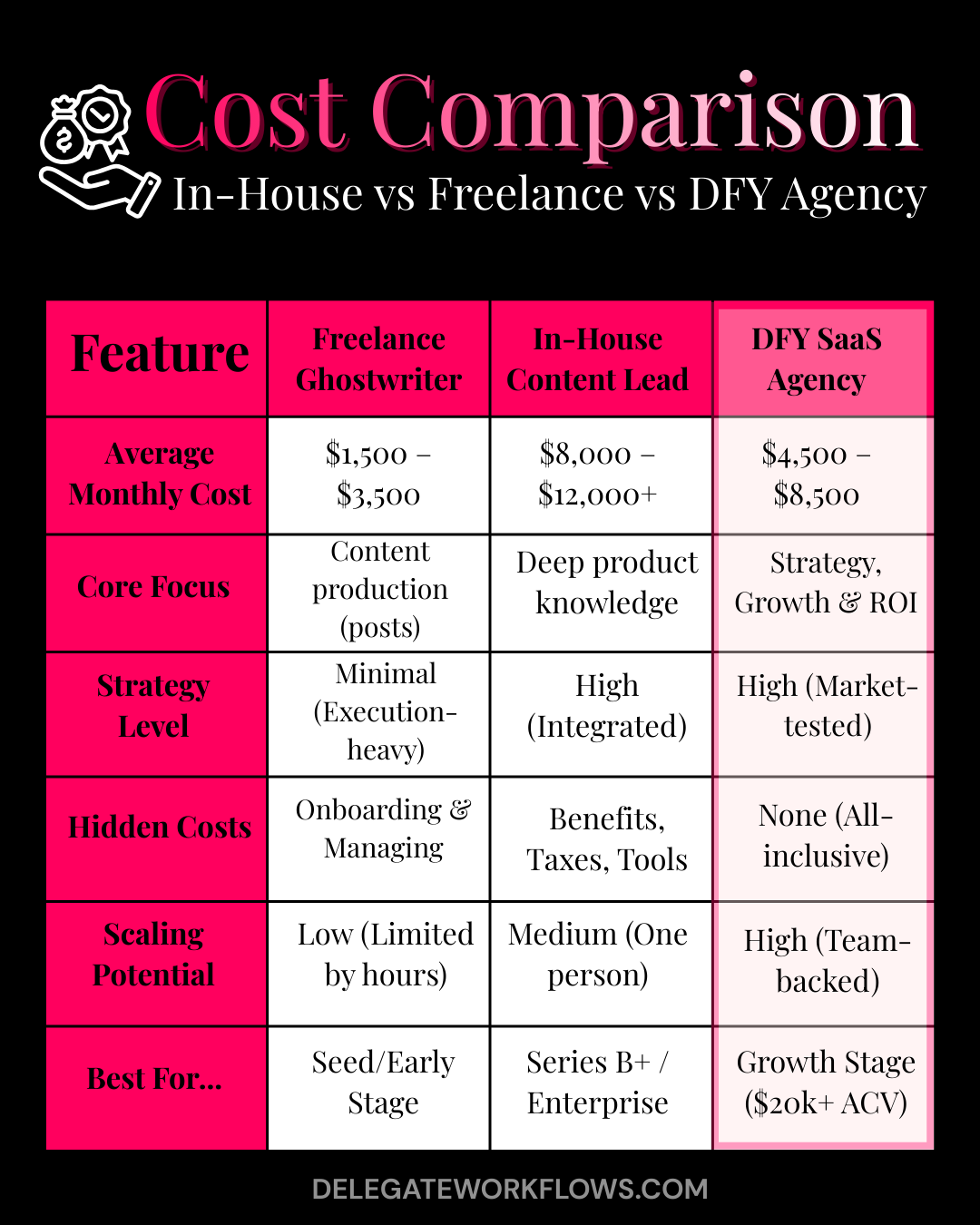
Which one is right depends on where you are.
Early-stage founders often prefer the freelancer route because it’s flexible and low-risk.
Growth-stage companies with $25K+ ACVs often get more from an agency because they need the full strategy, not just content.
The AI vs Human Question
This conversation is unavoidable now.
Pure AI-generated content is fast and optimized. It can churn out ideas and variations quickly. But it often sounds generic.
But often lacks:
- Founder nuance
- Technical depth
- Authentic voice
Pure human work is genuine and nuanced. But it can be slow, and it might not be optimized for platform algorithms.
In practice, the most effective model in 2026 is hybrid.
AI helps with research, with structuring ideas, and with testing what resonates.
A human strategist then shapes that into something that actually sounds like you, that understands the complexity of your sales process, and builds real relationships instead of just broadcasting.
When Done-For-You LinkedIn Is Not Worth It
DFY may not be worth investing in, if:
- Product-market fit is still uncertain
- ACV cannot justify even one incremental deal covering the cost
- There is no sales process to convert inbound interest
- Leadership is unwilling to participate visibly
LinkedIn amplifies what’s already true about your business. It can’t fix what’s broken at the foundation.
How Long Until You See ROI?
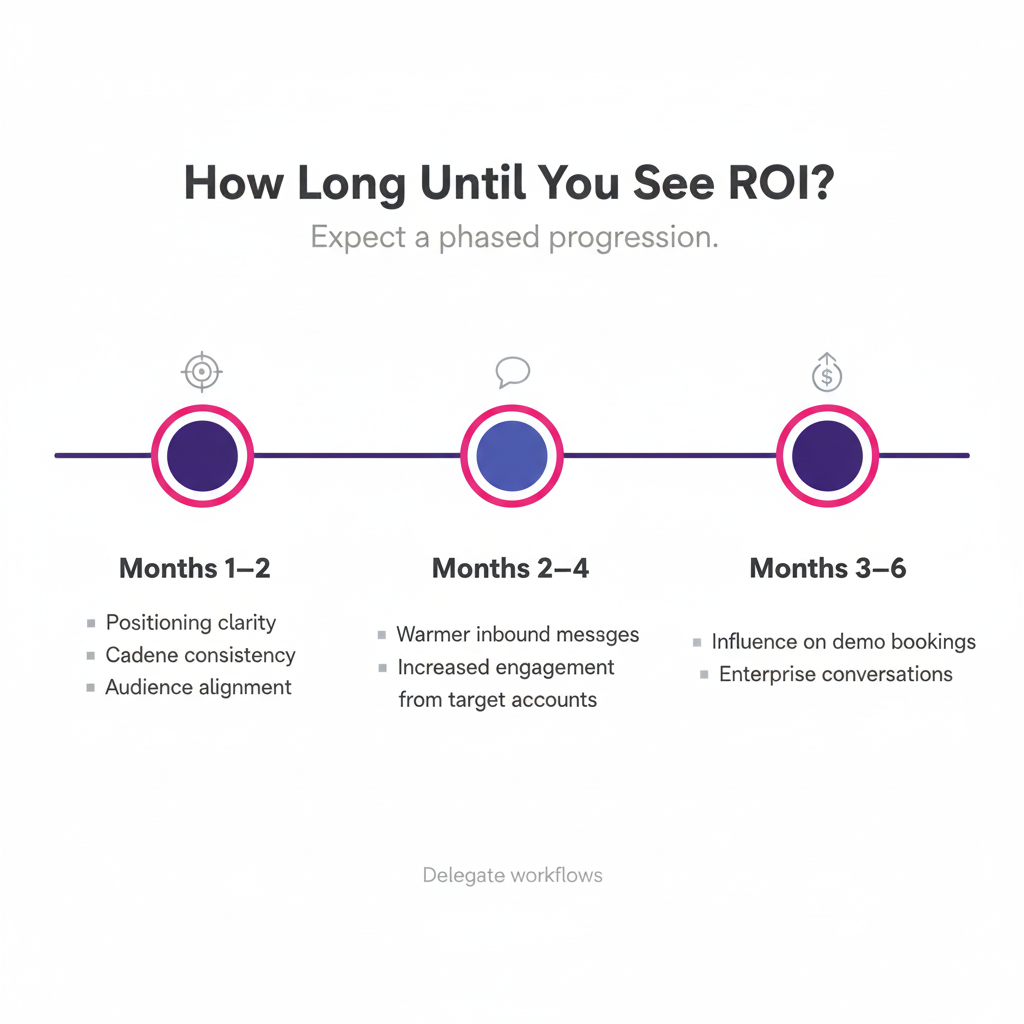
For enterprise sales, the impact might not look like a spike in leads. It might look like shorter deals or higher close rates. It’s compounding, not immediate.
Choosing a Partner
If you decide to explore this, don’t just look at their portfolio or their case studies. Look for people who understand your specific situation.
Ask them:
- Do you understand our sales model (PLG vs enterprise vs hybrid)?
- Can you translate technical product updates into strategic narratives?
- Do you measure demo-ready leads instead of vanity metrics?
- Can you demonstrate pipeline influence in past engagements?
- What is your engagement strategy beyond publishing posts?
- How do you integrate AI without diluting founder voice?
Most providers will tell you what they do. Fewer explain how their work connects to revenue.
So, Done for you LinkedIn services, worth it for saas companies?
It is worth it when:
- ACV and LTV support the investment
- Leadership time has higher-leverage priorities
- LinkedIn aligns with ICP behavior
- A sales engine exists to convert demand
It’s not a growth shortcut. It’s not going to save a broken product or an underfunded sales team.
But it is positioning infrastructure, especially important if you’re competing in a crowded space where nobody knows your name yet. The real decision is whether you build that system internally or accelerate it through a specialized partner.
If the math works and the strategy is aligned, the investment becomes defensible. If the fundamentals aren’t solid yet, invest in those first.
This isn’t ideological. It’s structural. It depends on your business, your stage, and what actually matters to your buyers.
That’s the honest answer.
Hi, I am Shruthi R.
I work with founders to simplify growth through smarter systems, structured content, and operational support that actually moves the needle.
My goal is to help you focus on leading while the right workflows run in the background.
Want to see how it works? Explore my services and case studies, or book a call to discuss your next stage of growth.
Pingback: LinkedIn Content System for B2B Consultants in 2026
Pingback: Blog Management Services for Coaches & Consultants: 2026 Essential Checklist
Pingback: Why Commenting Is the Real LinkedIn Growth Strategy for B2B Founders in 2026