
In Short
- In 2026, LinkedIn AI analyzes your posts, comments, and content patterns to define your professional identity
- It builds a machine-readable version of your expertise, not just your profile
- Inconsistent or generic content can misrepresent your positioning
- A clear, system-driven content strategy helps LinkedIn AI understand your authority and expertise
A few years ago, posting occasionally on LinkedIn was enough to stay visible.
Not anymore.
In 2026, LinkedIn is no longer just a content platform. It is a data system, one that is constantly learning from what you write, how you engage, and what you choose to talk about.
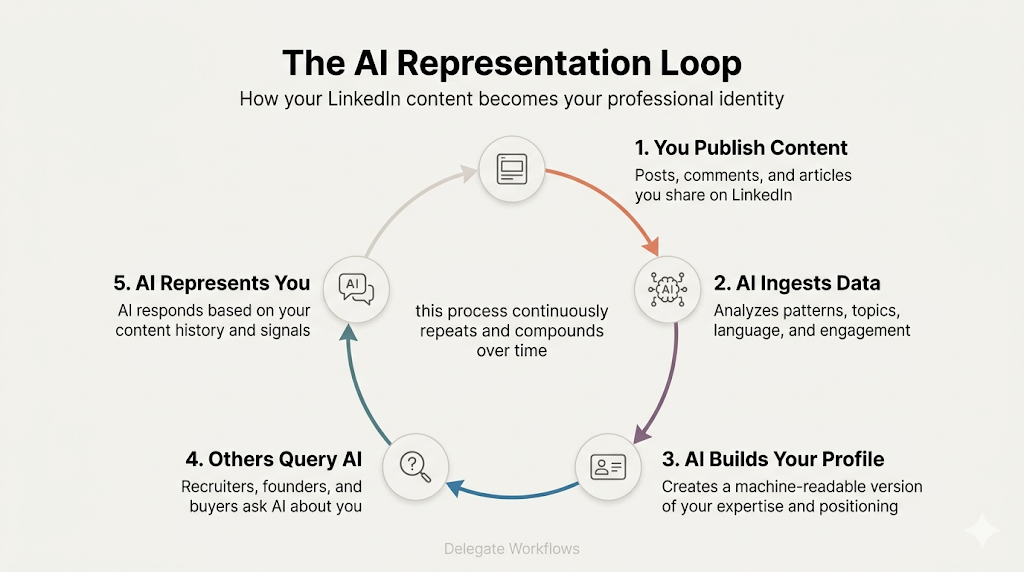
A recruiter asks an AI assistant: “Is this founder a strategic operator or just a content creator?” The AI doesn’t look at your headshot. It doesn’t read your bio the way a human would. It synthesizes every post, comment, and article you’ve published on LinkedIn and returns a verdict, a machine-readable profile of who you are professionally.
This isn’t a future scenario. As of November 3, 2025, LinkedIn officially switched its default setting to use member profile data and user-generated content to train its AI models. If you haven’t manually opted out, every post you’ve published since is actively shaping the AI representation that speaks for you in rooms you’ll never enter.
And here’s the shift most B2B founders haven’t fully processed yet:
You’re not just building a personal brand. You’re shaping how AI will represent you.
The question is, “What does the AI say about me when someone asks?”, not“What does my LinkedIn look like?”
What is AI Representation on LinkedIn?
AI Representation is how LinkedIn’s systems and external AI tools interpret your posts, comments, and profile data to build a machine-readable version of your professional identity.
This version of you is increasingly used when:
- Recruiters evaluate candidates
- Founders vet potential partners
- Buyers research service providers
Before someone speaks to you, AI may have already formed an opinion about you.
Why This Matters Now? (The Scale of LinkedIn’s AI Shift)
LinkedIn’s influence has reached a point where this shift can’t be ignored.
The platform now has over 257 million users in the U.S. alone
More than 65 million are decision-makers
Founder-led profiles are rising rapidly, with a 69% increase in “Founder” titles year-over-year
At the same time:
Engagement is up by ~30%
Video impressions have surged
And most marketers are already using AI in some capacity
This creates a simple reality:
More content is being created. More data is being generated. And more of your professional identity is being inferred, not directly stated.
While 98% of B2B marketers actively publish on LinkedIn, the vast majority are operating as if their content is purely human-to-human. They don’t realize they’re simultaneously training the AI that will eventually represent them.
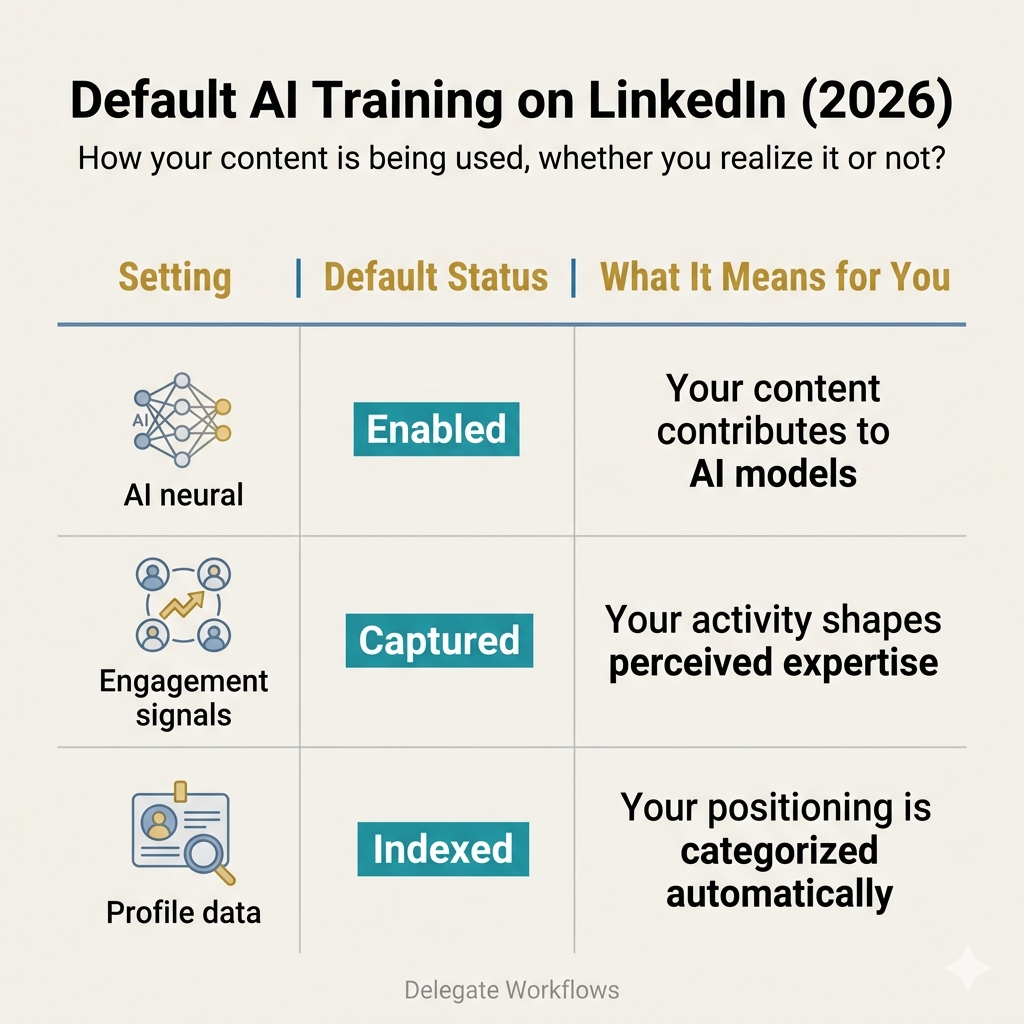
Default LinkedIn AI Training
In late 2025, LinkedIn made a quiet but significant change.
By default, user data- including posts, comments, and profile activity- is now used to train AI systems.
You can opt out. But you have to do it manually.
It’s about who controls your professional narrative, explicitly or implicitly.
How LinkedIn AI Sees You vs How People See You
Most founders still optimize their content for human readers. But humans and AI read your LinkedIn profile in fundamentally different ways.
They focus on:
- Storytelling
- Personality
- Visual appeal
It’s fast, visual, and emotionally influenced.
But AI evaluates something else entirely.
It looks for:
- Topic consistency
- Language patterns
- Depth of insight
- Repetition of ideas
It doesn’t see your photo. It sees your pattern.
When a recruiter asks an AI, “Is this founder a strategic thinker?” the AI doesn’t consult your headline. It runs your content history through a semantic model and returns a confidence score.
What feeds that confidence score?
Three signals that most founders underestimate:
Comments, not just posts:
Posts show what you want to project. Comments reveal what you actually think. AI models weigh authentic engagement, substantive replies, original perspectives added to others’ threads, more heavily than broadcast content.
Consistency of expertise:
Publishing 20 posts on 20 different topics signals a generalist. Publishing 20 posts that circle back to the same core thesis from different angles signals authority. The AI recognizes the difference.
Depth positioning:
Long-form articles, specific data citations, counterintuitive takes, these are semantic markers that distinguish a “strategic operator” from a “content producer” in the AI’s classification.
So while a human might see you as “insightful,” AI might classify you as “generic” if your content lacks depth or consistency.
That gap is where most positioning breaks.
From Personal Brand to AI Proxy
Your LinkedIn presence is no longer just a profile. It’s becoming an AI proxy.
Think of it this way:
If someone asks an AI tool, “Is this founder a strategic thinker?” The answer won’t come from your bio.
It will come from:
- The quality of your posts
- The clarity of your thinking
- The consistency of your ideas over time
Every post, every comment, every interaction adds to that dataset. And over time, that dataset becomes a predictive version of you.
Context Poisoning
Not all content strengthens your positioning. Some of it weakens it. This is where context poisoning happens.
Context poisoning is when low-quality, repetitive, or generic content signals to AI that you lack depth or differentiation.
Examples include:
- Surface-level “Agree?” posts
- Overused frameworks without original insight
- AI-generated content with no unique perspective
The risk isn’t just low engagement. It’s misclassification. You’re not just being overlooked. You’re being grouped into the wrong category.
Why Most B2B Founders Get This Wrong
On the surface, most LinkedIn strategies look the same. Consistent posting, Clean visuals, Trending formats
But underneath, there are two very different approaches:
1. Schedule-Driven Content
- Focused on frequency
- Driven by visibility
- Lacks a clear positioning system
2. System-Driven Content
- Built around a defined expertise
- Reinforces specific ideas consistently
- Compounds into authority over time
Both look identical in a feed. Only one trains AI and your audience to understand what you actually stand for.
Founders who shift to a system-driven approach don’t just grow faster; they build authority that compounds.
How LinkedIn AI Currently Sees You
If your content is already being used as training data, it’s worth understanding what it’s saying about you.
Start with this simple audit:
Step 1: Use an AI tool and ask:
“Based on this LinkedIn content, what is this person known for?”
Step 2: Review the output
- Is it specific or generic?
- Does it reflect your intended positioning?
- Does it show depth?
Step 3: Identify gaps
- What’s missing?
- What’s being overemphasized?
Step 4: Correct through content
- Create posts that reinforce what you want to be known for
- Reduce content that dilutes your positioning
Over time, this shifts your AI representation in a measurable way.
Should You Avoid AI Training?
Not necessarily.
Opting out may reduce exposure, but it doesn’t solve the core issue.
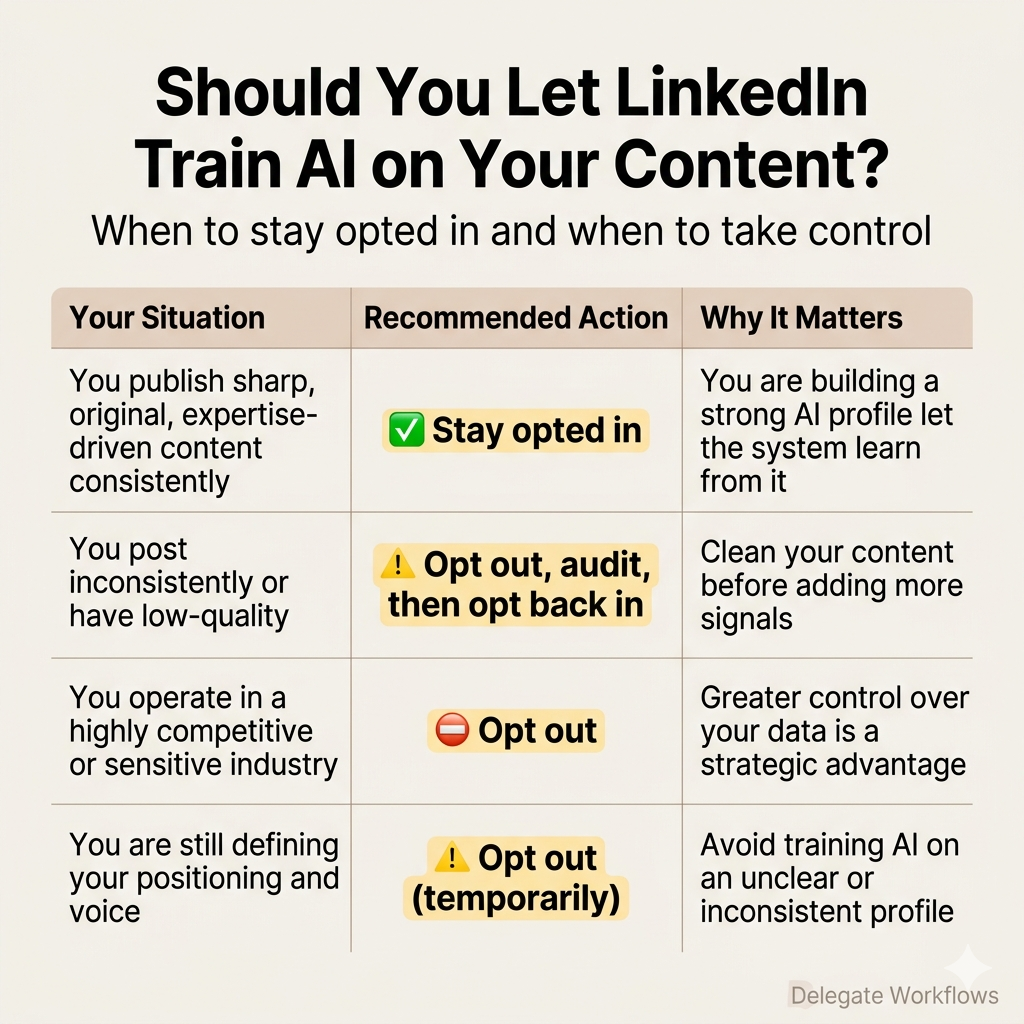
The better approach is intentional participation.
- If your positioning is unclear → refine before scaling
- If your expertise is strong → let the system learn from it
The goal isn’t to avoid AI.
It’s to control what it learns about you.
How to Control What LinkedIn AI Trains On
Before deciding whether to opt out, understand what you’re actually controlling and what you’re not.
Opting out means your future content and profile updates will not be used to train LinkedIn’s generative AI models going forward. It does not retroactively remove data already ingested. It also does not prevent LinkedIn from using your data for other purposes outlined in their broader Terms of Service.
How to opt out (as of early 2026):
- Go to Settings & Privacy on your LinkedIn profile
- Select Data Privacy from the left navigation panel
- Click on Data for Generative AI Improvement
- Toggle off “Use my data to improve LinkedIn’s AI”
What This Means Going Forward
Personal branding on LinkedIn used to be a human-to-human game. You optimized for the recruiter skimming your profile, the investor scrolling their feed, and the potential client deciding whether to reply to your message.
That’s still important. But now there’s a second audience, one that never sleeps, never forgets a post, and synthesizes your entire professional history into a verdict before a human ever sees your name. That audience is AI.
LinkedIn content is no longer just communication.
It shapes:
- How you’re discovered
- How you’re evaluated
- And increasingly, how you’re represented when you’re not in the room
That makes your content strategy more than a growth tool. It becomes a reputation system.
Turn Your Content Into a System That Compounds
If your current content strategy is built on consistency alone, it may be creating visibility but not clarity. And in a system where AI is learning from everything you publish, clarity is what compounds.
If you want to:
- Audit how your content is positioning you
- Build a system that reinforces authority
- And ensure your AI representation reflects your actual expertise
You can book a strategy call and get a clear breakdown of where you stand and what to fix.