
In Short
A repeatable LinkedIn content system for B2B consultants includes:
- Clear revenue-linked positioning
- Four sales-aligned content pillars
- A weekly batching workflow
- Structured distribution beyond posting
- ROI tracking tied to pipeline, not vanity metrics
When executed consistently, consultants can expect early engagement signals within 30 days, measurable pipeline influence within 90 days, and authority compounding over 6 months.
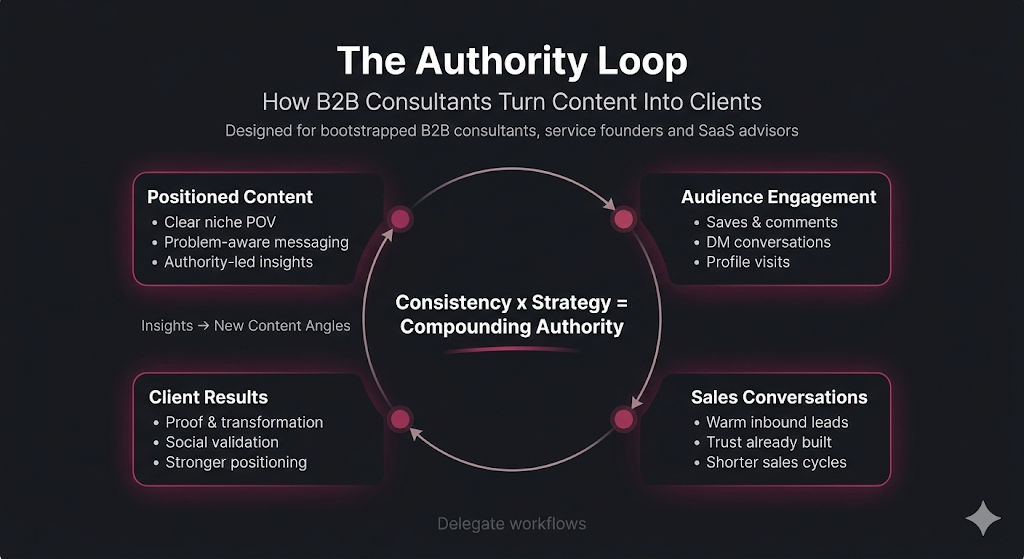
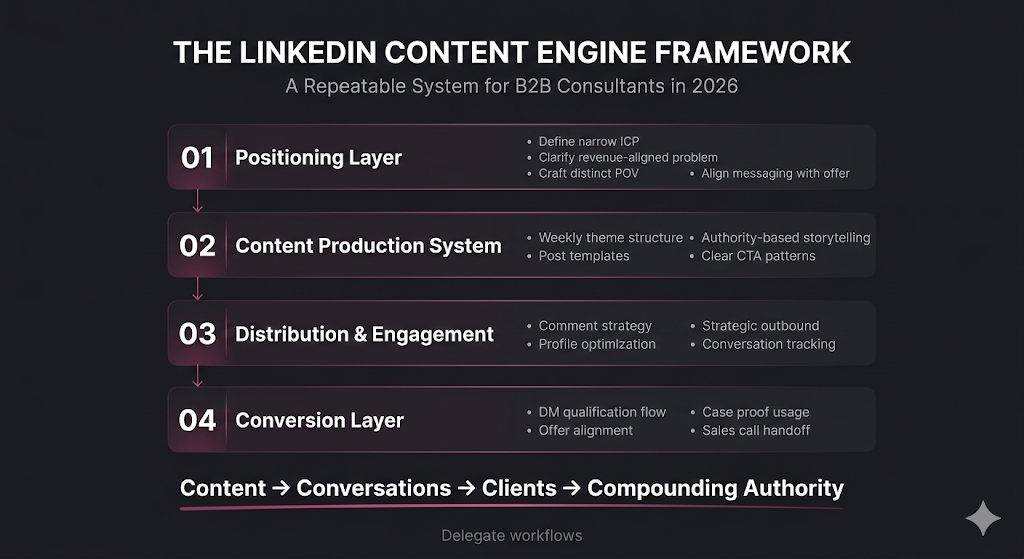
A LinkedIn content system for B2B consultants only works when positioning, production, and distribution operate as a single system.
Why Most B2B Consultants Fail to Build a LinkedIn Content System
Most B2B consultants approach LinkedIn the way they approach social media, as a place to stay visible.
They share insights. They comment occasionally. They experiment with formats. But nothing compounds.
The issue isn’t effort. It’s the absence of a system.
LinkedIn does not reward random activity. According to LinkedIn’s own B2B audience targeting research, consistent authority-led content significantly outperforms sporadic posting.
It rewards structured consistency aligned with a clear market position.
For bootstrapped consultants and agencies in the U.S., LinkedIn is often the highest-leverage client acquisition channel available. There is no paid acquisition requirement. No complex tech stack. No algorithm dependency outside your niche.
But without a repeatable engine, momentum stalls.
A scalable LinkedIn system transforms content from an obligation into an asset.
What Is a LinkedIn Content System for B2B Consultants?
A LinkedIn content system for B2B consultants is a structured system that turns subject matter expertise into consistent visibility, qualified conversations, and measurable pipeline influence through repeatable positioning, production, and distribution workflows.
It is not simply “posting more consistently.
It is a deliberate process that connects insight to revenue.
This distinction matters because without it, founders and consultants remain trapped in reactive mode – searching for ideas, publishing rarely, and mistaking engagement metrics for actual business impact.
Most consultants lack clarity around four foundational elements:
- What specific positioning drives their content?
- How does that content map to actual sales conversations?
- How to sustain production without burning out?
- How to measure return beyond vanity metrics.
Without those foundations, no LinkedIn content system for consultants scales.
Step 1: Define Revenue-Linked Positioning
Before building a content engine, you must clarify what revenue problem your expertise solves.
Many consultants position themselves around industry (“marketing consultant,” “operations advisor”).
That’s too broad.
Instead, define:
- Who you serve (specific buyer profile)
- The expensive problem they urgently need solved
- Your differentiated belief or approach
- The proof behind your method
Example:
Instead of: “Helping startups grow.”
Refine to: “Helping B2B agencies reduce client churn by fixing delivery bottlenecks.”
This level of clarity does three things:
- Reduces content fatigue (you know what to talk about).
- Attracts the right profile visitors.
- Increases inbound quality over volume.
Positioning is the foundation of any scalable LinkedIn content system.
Step 2: Build 4 Sales-Aligned Content Pillars
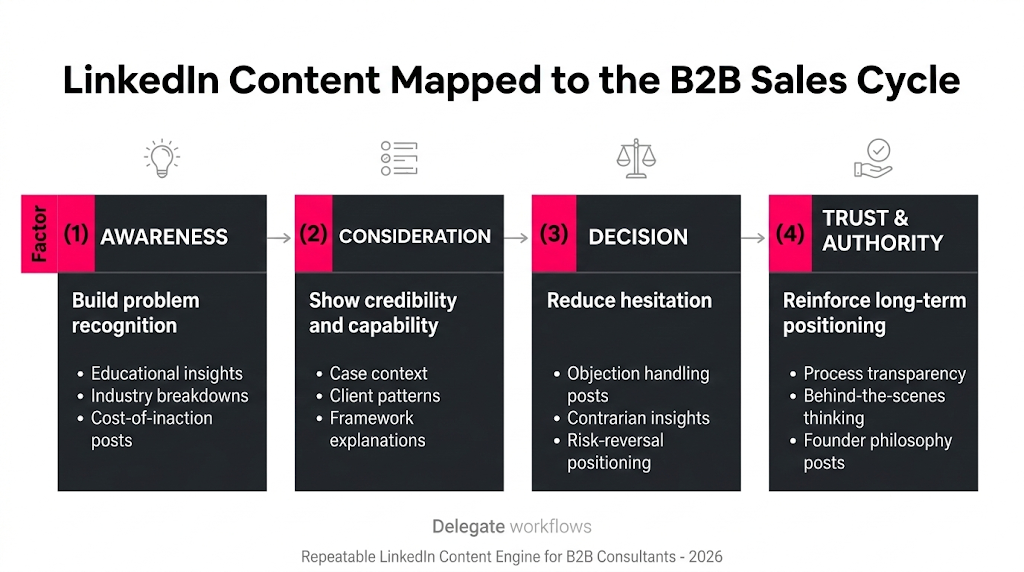
A repeatable LinkedIn content system must map to the B2B sales cycle. Research on the modern B2B buyer journey shows decision-making is nonlinear and trust-driven.
Most consultants post educational content only. Education creates awareness, but not decisions.
Use four core pillars:
1. Problem Education
Explain the cost of ignoring the issue you solve.
Example: “Why most agencies lose 20% of revenue to invisible operational leaks.”
2. Contrarian Insight
Challenge industry assumptions.
Example: “More leads won’t fix your churn problem.”
3. Proof & Case Context
Share anonymized patterns from client work.
Example: “One agency reduced client churn by restructuring onboarding.”
See how this LinkedIn content system works in real client case studies.
4. Process Transparency
Show how you think.
Example: “Here’s the framework we use to diagnose delivery breakdowns.”
When these four pillars rotate weekly, you create progression:
Awareness → Consideration → Decision confidence → Trust reinforcement
This increases sales velocity, not just impressions
Step 3: Build a Repeatable LinkedIn Content Workflow
Consistency fails when creation is reactive.
Instead of writing posts daily, batch weekly.
Example workflow:
Day 1 – Idea Capture
- Review sales calls
- Note recurring objections
- Record voice notes with insights
Day 2 – Drafting
- Convert one core idea into 3–4 posts
- Apply structure (Hook → Insight → Example → Takeaway)
Day 3 – Editing
- Strengthen hooks
- Tighten language
- Remove generic phrasing
Day 4–5 – Schedule & Engage
- Publish strategically
- Engage with target buyer accounts
Batching reduces friction and increases output stability.
If your billable rate exceeds the time cost of drafting, this is where structured writing support can increase leverage, without losing founder voice.
Step 4: Build a Distribution Layer (Beyond Posting)
Publishing is not distribution.
Many ghostwriting agencies stop at scheduling posts. That caps growth.
A scalable LinkedIn content system includes:
- Strategic commenting on adjacent authority accounts
- DM follow-ups with warm responders
- Repurposing posts into newsletter/blog content
- Profile optimization aligned with content themes
For example:
A consultant posts about onboarding inefficiencies. A founder comments with agreement. A short DM exchange leads to a discovery call.
This is not luck. It’s systemized visibility.
Step 5: Measure What Actually Matters
Vanity metrics mislead consultants.
Impressions feel good. They rarely correlate with revenue.
Instead, track:
- Profile views from ideal clients
- Inbound DMs referencing posts
- Sales calls influenced by LinkedIn
- CRM source tagging (“LinkedIn Content”)
Three simple tracking methods:
- Ask every discovery call: “How did you find us?”
- Add UTM tracking to your profile link.
- Use a CRM tag for LinkedIn-sourced opportunities.
How Long Does It Take to See Results from a LinkedIn Content System?
Realistic expectations matter.
- 30 days → Engagement pattern clarity
- 90 days → Pipeline attribution signals
- 6 months → Authority compounding
LinkedIn authority behaves like interest: slow early, exponential later.
When Should a Consultant Hire LinkedIn Writing Support?
Outsourcing is justified when:
- Your hourly billable rate exceeds the cost of execution
- You have ideas but no consistency
- Inbound traction exists but is unpredictable
But outsourcing without positioning clarity leads to generic content.
The system must exist before delegation scales it.
For SaaS-specific execution, read our breakdown of done-for-you LinkedIn services for SaaS companies.
The Compounding Advantage of a Repeatable Engine
Bootstrapped B2B consultants do not win by posting more.
They win by building systems that:
- Clarify expertise
- Build visible authority
- Warm up sales conversations
- Reduce client acquisition friction
Most consultants don’t need more ideas. They need a structure that turns existing expertise into predictable authority.
A repeatable LinkedIn content system in 2026 is not about volume. It is about structured, revenue-aligned consistency.
If your LinkedIn activity feels effort-heavy but impact-light, it may be time to audit the system behind it. Structured execution often changes more than increased output ever will.
Consultants looking for structured execution can explore our LinkedIn strategy and execution support.
And once the system is in place, execution becomes scalable.
Hi, I am Shruthi R.
I work with founders to simplify growth through smarter systems, structured content, and operational support that actually moves the needle.
My goal is to help you focus on leading while the right workflows run in the background.
Want to see how it works? Explore my services and case studies, or book a call to discuss your next stage of growth.
How does a LinkedIn content system work for B2B consultants?
A LinkedIn content system for B2B consultants is a structured system that turns expertise into consistent visibility, qualified conversations, and measurable pipeline influence through repeatable positioning, production, and distribution.
How long does a LinkedIn content system take to generate results?
Most consultants see engagement pattern clarity within 30 days, early pipeline attribution within 90 days, and authority compounding after six months of consistent execution.
Pingback: Why Commenting Is the Real LinkedIn Growth Strategy for B2B Founders in 2026
Pingback: How LinkedIn AI Uses Your Content to Define Your Professional Identity (A 2026 Guide)
Pingback: The Real Cost of Hiring a Virtual Assistant (Why $5/Hour VAs Cost You More)