
You found a virtual assistant for $5 an hour.
You did the math: 20 hours a week, $100 a week, $400 a month. Compare that to a full-time hire at $4,000/month, and it feels like you have cracked the code.
You have not. Not yet.
Because the real cost of hiring a virtual assistant has almost nothing to do with their hourly rate and everything to do with what you are doing while managing them.
This is the calculation most articles skip. This one will not.
The Hidden VA Cost That Drains Your Revenue
Here is the math that should make every B2B founder pause.
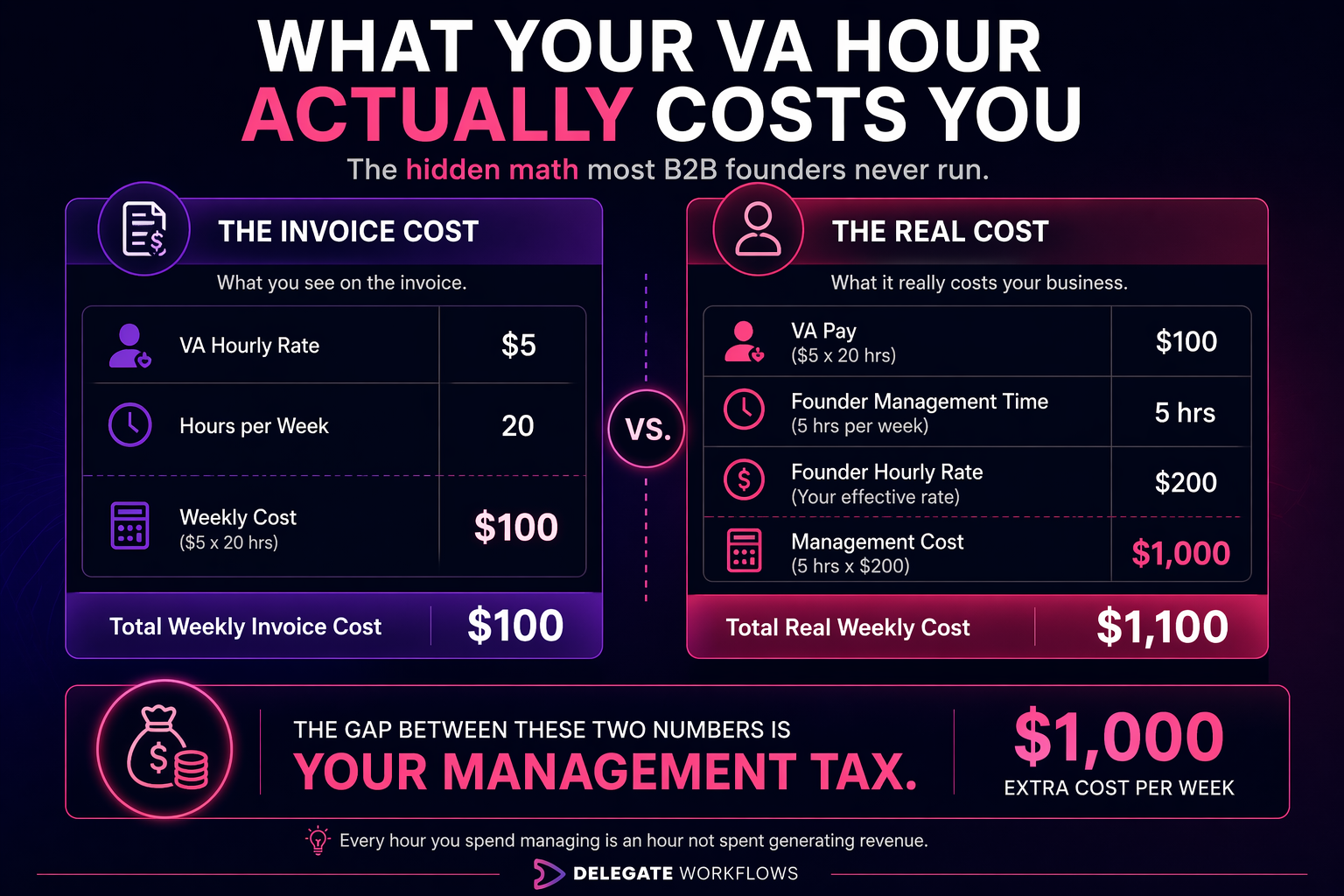
If your time is worth $200 an hour (a conservative figure for a founder billing at consultancy rates) and you spend just 5 hours a week onboarding, correcting, briefing, and following up with your VA, that is $1,000 of your time gone.
Add the $100 you are paying the VA.
Your “cheap” VA is now costing you $1,100 a week.
This is what operations experts call the Management Tax: the invisible cost of founder time spent managing instead of generating revenue. It is the single most important number in the real cost of hiring a virtual assistant, and it almost never appears in any VA pricing guide.
According to the U.S. Small Business Administration, over 82% of small businesses in America are solo or micro-founder operations. These are exactly the businesses where the founder’s time is the most valuable and most vulnerable resource. Spending it on VA management is not delegation. It is a disguised bottleneck.
The True Cost of Hiring a Virtual Assistant
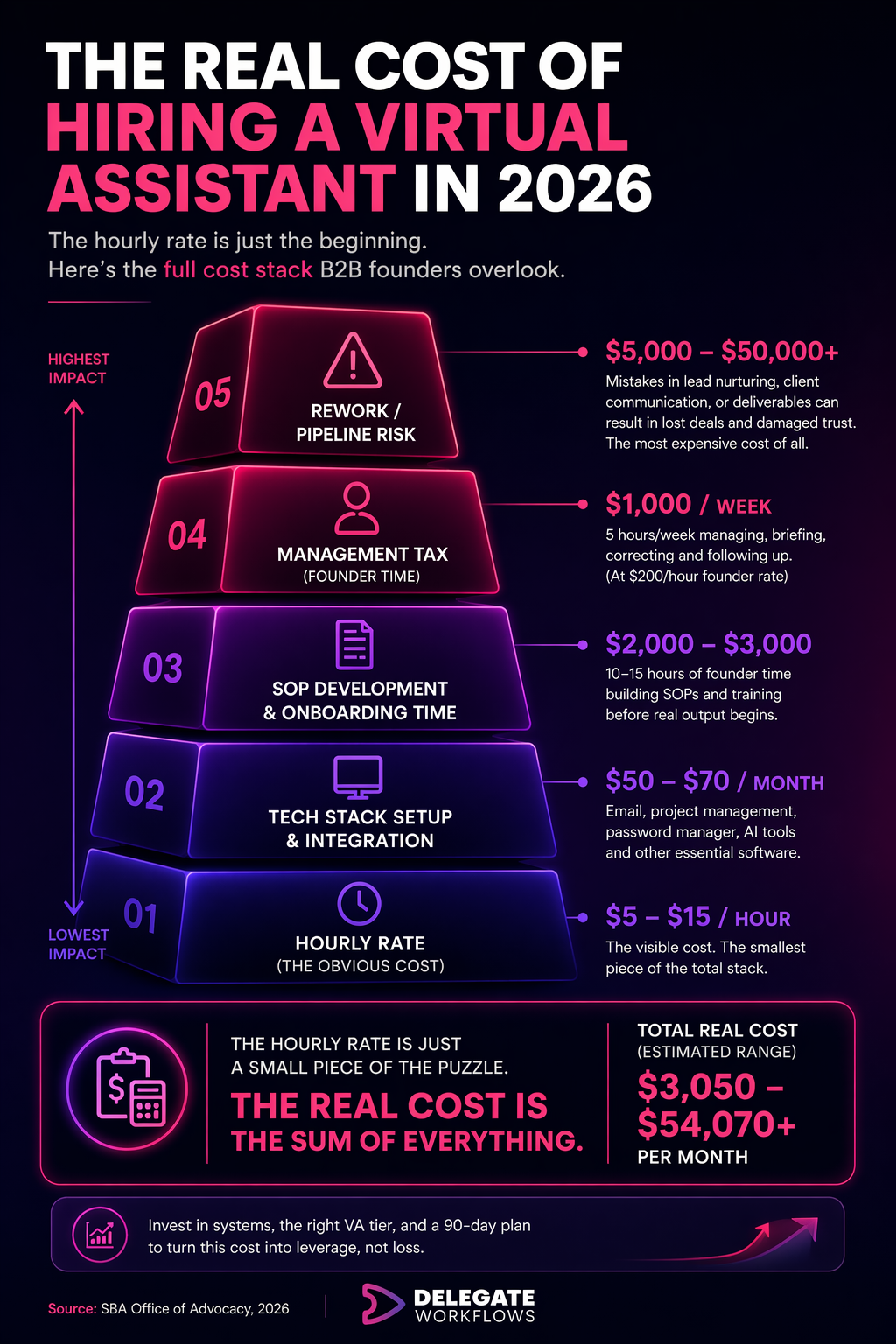
When B2B founders calculate VA costs, they look at the hourly rate. The real cost of hiring a virtual assistant is a full stack, not a single line item.
The hourly rate is just the beginning. Here is what sits underneath it.
Onboarding and SOP Development: Building the standard operating procedures your VA needs to work without constant input takes real time. Most founders underestimate this at 10 to 15 hours in the first month alone. At $200/hour of founder time, that is $2,000 to $3,000 added to the real cost of hiring a virtual assistant before your VA completes a single deliverable.
Tech Stack Integration: A functioning VA setup typically requires a dedicated email seat ($15/month), project management software ($10 to $25/month), a password manager ($5/month), and AI tool access ($20/month). Budget an additional $50 to $70/month in software as part of the real cost of hiring a virtual assistant.
The 90-Day Break-Even Window: Research consistently shows that most VAs do not become profit-positive for a founder until month three. Months one and two exist in a Negative ROI Zone: high management input, high error rates, and low output quality. Understanding this timeline is critical to evaluating the real cost of hiring a virtual assistant, not just the short-term expense.
The Rework Cost: This is the one that stings hardest in B2B. A VA who mishandles a lead nurture sequence, sends an off-brand proposal, or books the wrong prospect into your calendar does not just waste an hour. In a B2B context, a mismanaged warm lead can represent $5,000 to $50,000 in lost pipeline, a hidden but very real part of the real cost of hiring a virtual assistant.
Why Hiring a $5/Hour VA for B2B Tasks Costing You More
The $5/hour VA market exists. It is real, and for certain tasks like data entry, basic scheduling, and repetitive admin, it can work.
But B2B founders consistently make the same mistake: they hire a $5/hour VA for tasks that require $30/hour thinking.
Crafting outreach messages. Managing client communications. Coordinating across time zones. Representing your brand in any external-facing capacity.
These tasks require context, judgment, and communication skills. When you under-hire for them, you do not save money. You create rework, brand inconsistency, and the slow erosion of client trust. These are costs that never appear on an invoice but show up directly in your churn rate and referral volume.
The real cost of hiring a virtual assistant at the wrong tier is not the hourly difference. It is the compounding cost of fixing what the wrong hire repeatedly gets wrong.
The Difference Between Hiring a VA and Actually Getting Your Time Back
The founders who get genuine ROI from VA hiring do three things differently.
They delegate systems, not tasks. Instead of sending ad hoc instructions, they build a repeatable delegation workflow that the VA can execute independently. This reduces the Management Tax from 5 hours a week to under 1.
They match task complexity to VA tier. They use lower-cost VAs for genuinely low-judgment work and invest in higher-tier support for client-facing or revenue-linked tasks. They do not try to stretch one hire across both categories.
They set a 90-day evaluation framework. They do not assess ROI in week two. They track output quality, time saved, and Management Tax across a full quarter before drawing conclusions.
This is the difference between hiring a VA and building a delegation system. One saves you money on paper. The other actually gives you your time back and reduces the real cost of hiring a virtual assistant over time.
3 Questions Every B2B Founder Should Answer Before Hiring a Virtual Assistant
Before you post your next VA job description, run this calculation:
- How many hours per week will I realistically spend managing this person?
- What is my effective hourly rate as a founder?
- What is the Management Tax I am about to take on?
If the total cost exceeds what you would pay for a better-matched, higher-tier VA, you already have your answer.
The real cost of hiring a virtual assistant is not what you pay them. It is what you pay in time, systems, and client relationships when the hire is not set up to succeed from day one.
Stop Paying the Management Tax. Start Building a Delegation System.
The real cost of hiring a virtual assistant is not what you pay them. It is what you pay in time, systems, and client relationships when the hire is not set up to succeed from day one.
Most B2B founders do not have a VA problem. They have a delegation system problem.
If you want to hire your first VA without the 90-day stumble, the rework spiral, or the hidden Management Tax, let us map it out together.
Pingback: 5 Signs You’ve Outgrown Your VA (And When to Stop Relying on One)
Pingback: General VA vs. Specialized VA: Which One Does Your Business Actually Need in 2026?