
B2B marketing in 2026 faces a mystery.
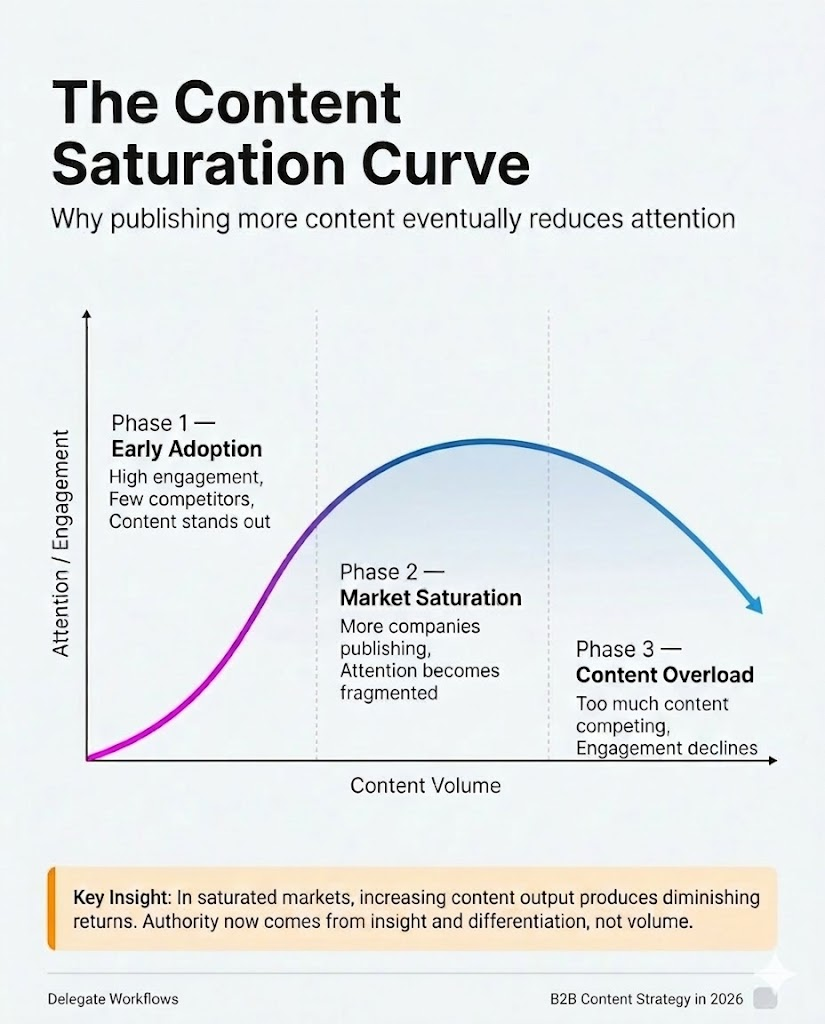
Companies are publishing more content than ever before and getting less in return.
The scale of the market explains why.
The United States alone has about 36.2 million small businesses, and roughly 4.88 million operate in the professional, scientific, and technical services sector, the category that includes consulting, marketing, advisory, and design firms.
These businesses rely heavily on content to demonstrate expertise and attract clients.
At the same time, the marketing workforce producing this content is massive. The U.S. has more than 368,000 marketing managers,and industry estimates suggest around 2.5 million professionals work in marketing roles, expanding to nearly 6 million when adjacent roles like design, UX, and sales enablement are included.
Combine that with automation and AI adoption, 85% of B2B marketers now use AI tools to create content, and the result is predictable: a flood of articles, posts, and resources competing for the same attention.
This creates two distinct outcomes for companies trying to build visibility:
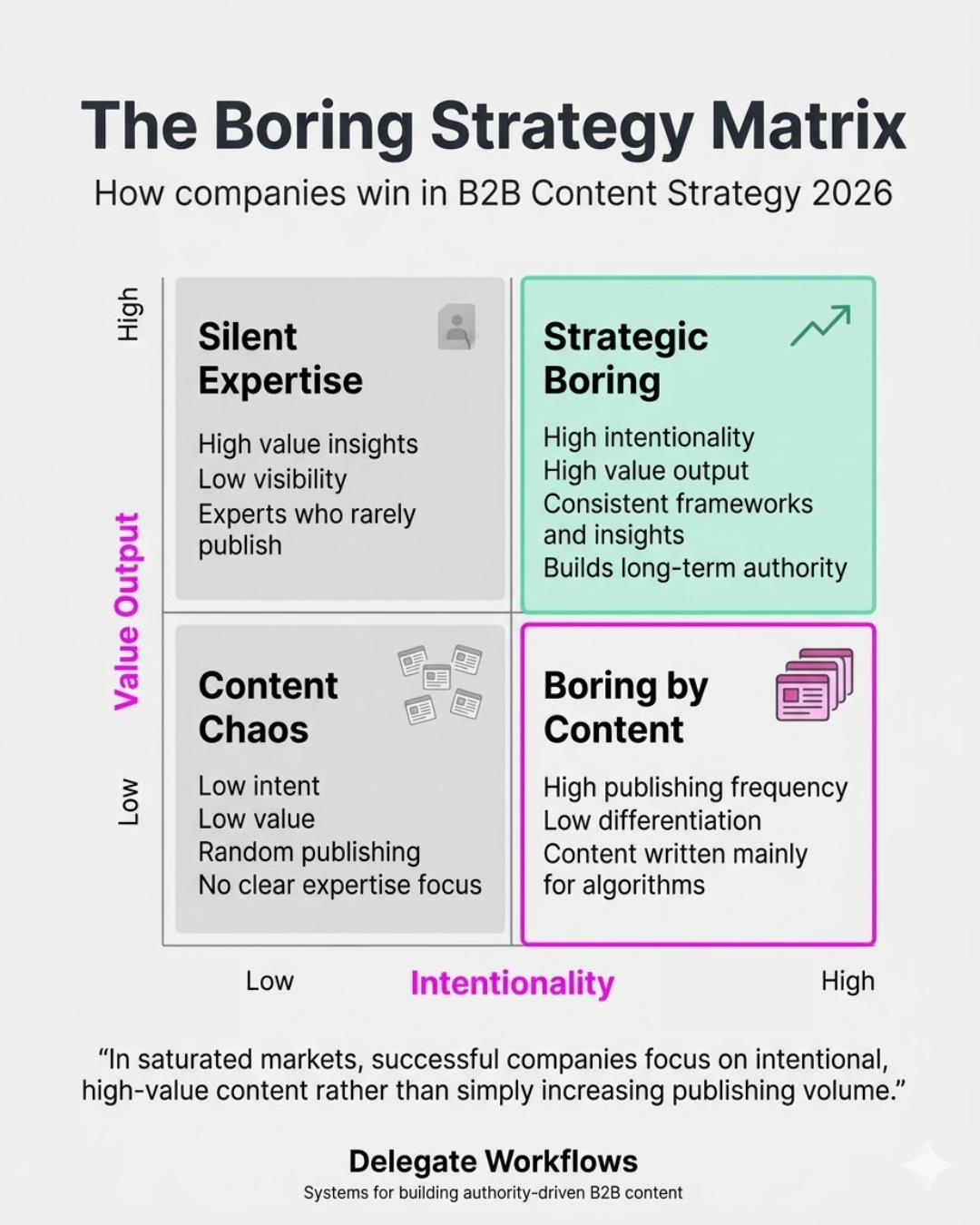
- Boring by Content – endless publishing that blends into the noise.
- Boring by Default – an intentionally simple, consistent system that builds long-term trust.
Both appear similar on the surface. But only one produces compounding returns.
Understanding that difference is now essential for any effective B2B content strategy in 2026.
In Short
- Content saturation is real. With millions of businesses publishing online and 85% of B2B marketers using AI for content creation, the internet is filled with similar articles competing for attention.
- Many companies fall into “Boring by Content”, producing large volumes of generic material that blends into the noise.
- Others adopt “Boring by Default”, a deliberately simple and consistent strategy focused on expertise, clarity, and repeatable insights.
- In saturated markets, consistency and depth outperform volume. Companies that publish fewer but more valuable pieces build stronger authority.
- The most effective B2B content strategies in 2026 treat content as a long-term system for sharing expertise, not just a publishing schedule.
What Is “Boring by Content” vs. “Boring by Default”?
The terms describe two fundamentally different approaches to content strategy.
Boring by Content
Boring by Content happens when organizations produce large volumes of content that lack differentiation or original insight.
Common characteristics include:
- High publishing frequency
- AI-generated summaries of existing ideas
- Surface-level industry commentary
- Repeated topics without new perspectives
- Content written primarily for algorithms rather than buyers
Ironically, this approach often comes from a desire to stay visible. Marketing teams believe more output will generate more leads.
But saturation has changed the equation.
Research shows 56% of B2B marketers struggle to connect content efforts to measurable ROI.
When companies respond by producing even more content, they often deepen the problem rather than solve it.
Boring by Default
Boring by Default is different.
It describes a deliberately simple, repeatable content strategy designed around expertise, clarity, and consistency rather than novelty.
Characteristics include:
- Fewer but higher-quality pieces
- Repeated frameworks and ideas
- Clear positioning around a specific expertise area
- Content designed to answer real buyer questions
- Long-term credibility building
Instead of trying to outproduce competitors, these companies focus on being consistently useful.
This approach may look “boring” because it avoids trends and flashy tactics. But strategically, it creates a stronger foundation for trust.
What Makes a B2B Content Strategy in 2026 Effective?
The rise of AI-assisted writing has dramatically lowered the cost of producing content.
But it has not lowered the cost of attention.
When thousands of organizations can generate articles instantly, the advantage shifts away from speed and toward insight.
The result is what many marketers now call the “sea of sameness.”
Articles begin to sound identical:
- similar headlines
- similar arguments
- similar examples
- similar conclusions
From a reader’s perspective, the experience becomes predictable.
And predictable content rarely earns attention.
This is particularly risky in B2B industries where expertise is the primary signal of credibility.
Why B2B Content Strategy in 2026 Requires Simplicity and Consistency
Buyer behavior has also changed.
A growing percentage of B2B buyers prefer to research independently rather than engage with sales teams early in the process.
Recent industry data shows 33% of B2B buyers prefer a completely rep-free purchasing experience.
This means that before a conversation with your company ever happens, potential clients are evaluating:
- Your articles
- Your insights
- Your frameworks
- Your explanations of complex problems
In many cases, your content is the first proof of expertise, especially on platforms like LinkedIn, where consistent publishing builds authority.
When that content looks indistinguishable from everything else in the market, buyers have no reason to remember you.
Strategic simplicity solves this.
Companies that adopt a Boring by Default approach focus on building recognizable expertise over time.
They repeat their frameworks. They deepen their ideas. They become associated with specific perspectives.
Instead of chasing attention, they build recognition.
The Boring Strategy Matrix
One useful way to understand this shift is through a simple framework based on two variables: Intentionality and Value Output.
AI Content Is Now a Commodity
The deeper reason this shift is happening is simple.AI has turned writing into a commodity activity.
When everyone can generate content quickly, the competitive advantage no longer lies in producing words.It lies in producing thinking.
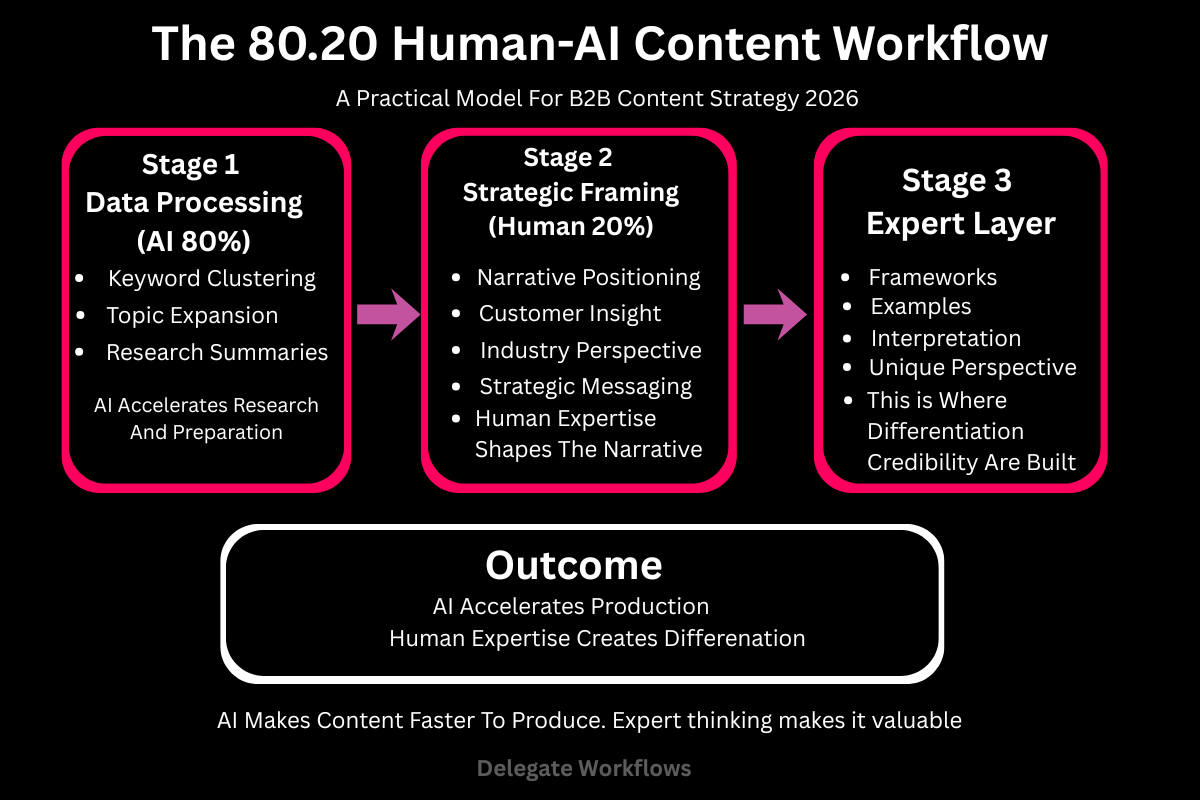
Effective teams increasingly follow a human-in-the-loop model:
- AI assists with research and drafting
- Humans shape the narrative and insights
A practical rule many organizations adopt is an 80/20 workflow:
AI handles 80% of the preparation
- Topic exploration
- Data gathering
- Structural drafts
Humans provide 20% of differentiation
- Interpretation
- Frameworks
- Industry perspective
That final layer is where credibility is built.
A Practical B2B Content Strategy Model for 2026
Companies looking to move away from content saturation often adopt a simpler strategic model.
1. Define a clear expertise territory
Instead of covering every industry topic, identify three to five areas your company must own.
These should align with the problems your clients hire you to solve.
Focus on fewer, deeper insights. One strong framework article outperforms ten trend roundups in both trust and longevity.
2. Build repeatable frameworks
Repetition builds recognition. Buyers need to see your thinking multiple times before it registers as expertise.
Frameworks make expertise memorable.
Examples include:
- matrices
- checklists
- diagnostic models
- operational guides
Framework-based content is often referenced by others, which increases visibility and credibility.
3. Reduce publishing frequency
Explain how systems work, not just what trends are emerging. Buyers are trying to solve operational problems, not follow the news.
Publishing fewer articles often improves quality and impact, especially when supported by structured blog management systems.
In saturated industries, depth tends to outperform volume.
4. Focus on buyer decision moments
Create content that answers questions buyers ask during evaluation:
- Implementation timelines
- Cost expectations
- Operational risks
- Strategy comparisons
This type of content directly supports purchasing decisions.
5. Choose consistency over creativity.
Buyers trust consistency more than novelty.
A company that says the same smart things for three years earns more credibility than one that pivots to every new trend.
The Real Risk Isn’t Being Boring
Many B2B companies worry that simplifying their strategy will make them less interesting.
But in reality, the biggest risk in modern marketing is being forgettable.
If your content sounds like every other article in your industry, it becomes part of the background noise.
Strategically “boring” content avoids that fate.
It prioritizes clarity over novelty, expertise over trends, and consistency over constant reinvention.
In 2026, the companies that succeed with content are rarely the ones publishing the most.
They are the ones building a clear, repeatable system for sharing expertise.
And over time, that system compounds into something far more valuable than attention.It becomes trust.
If your organization is trying to turn content into a predictable growth engine rather than an endless publishing cycle, the first step is often stepping back and redesigning the strategy behind it.
That shift from volume to intentionality is where real differentiation begins.
Building a Content System That Compounds
For B2B companies, the challenge in 2026 is not producing content, but building an effective B2B content strategy in 2026 that compounds over time.
That means focusing on consistency, clear expertise, and creating content that directly supports how buyers think, evaluate, and make decisions.
If your current strategy feels stuck between over-publishing and under-performing, the problem is rarely effort. It is almost always structured.
The fix is simpler than most teams expect.It starts with deciding what you actually want to be known for and having the discipline to say that, clearly, over and over again.
Most companies don’t need more content. They need a clearer B2B content strategy.
If that’s something you’re thinking through, we’re happy to help you figure out where to start.
What is a B2B content strategy in 2026?
A B2B content strategy in 2026 focuses on consistency, expertise, and depth instead of high-volume publishing. It prioritizes clarity and repeatable insights that build long-term trust.
What does “boring by default” mean in content strategy?
“Boring by default” refers to a simple, consistent content approach that focuses on expertise and clarity rather than chasing trends or producing large volumes of generic content.
Why is content saturation a problem in B2B marketing?
Because AI has made content easy to produce, many articles now look similar. This makes differentiation and original insight more important than ever.
Pingback: Why 2026 Is the Best Time for B2B Agency Owners to Invest in LinkedIn Personal Branding
Pingback: The Real Cost of Hiring a Virtual Assistant (Why $5/Hour VAs Cost You More)