
In Short
Professional blog management services help coaches and consultants turn content into authority, visibility, and revenue.
A strategic blog management partner should provide:
- Documented content-to-revenue mapping
- AI-assisted but human-led authority positioning
- Structured SEO and lifecycle optimization
- Distribution beyond publishing
- CRM-level attribution clarity
Without these systems, blogging becomes maintenance. With them, it becomes a compounding authority engine.
In 2026, AI has made it easier than ever to publish content and harder than ever to stand out.
Artificial intelligence has lowered the barrier to entry. Nearly every coach can generate blog posts, LinkedIn articles, and newsletters with assistance from AI tools. In fact, over 90% of marketers now use AI in their workflows, according to 2025 industry reports.
High-ticket executive coaching depends on authority, credibility, and trust, not volume. And that requires something far more sophisticated than occasional publishing, i.e., infrastructure.
For executive coaches operating at a premium level, blogging only makes sense if it contributes to measurable business growth. If it doesn’t influence pipeline, authority, or revenue, it’s simply an activity, not an asset.
For them, blogging stops working when it’s treated as a writing task instead of a business system.
Why Blog Management Services Matter for Coaches
1. The Hidden Opportunity Cost
Blogging isn’t just writing.
Managing a high-performing blog involves:
- Research and positioning
- Advanced SEO optimization
- Analytics and reporting
- Updating aging content
- Distribution strategy
- CRM alignment
Even conservative estimates suggest that monitoring and managing blog performance alone can consume up to 15 hours per week. For executive coaches billing premium retainers, that trade-off is expensive.
When your time shifts from client conversations to content administration, growth slows.
2. The Expertise Gap in an AI-Saturated Market
AI has made content production easy. It has not made strategic authority easy.
As content saturation increases, generic, AI-generated posts struggle to convert. Industry research shows that while 90% of marketers use AI, the most effective performers use it as augmentation, not replacement, preserving human voice and expertise.
Executive-level blog performance now requires:
- Technical SEO depth
- Structured internal linking systems
- Buyer-journey mapping
- CRM attribution modeling
- Generative Engine Optimization (GEO)
Few executive coaches have the time or desire to master these simultaneously.
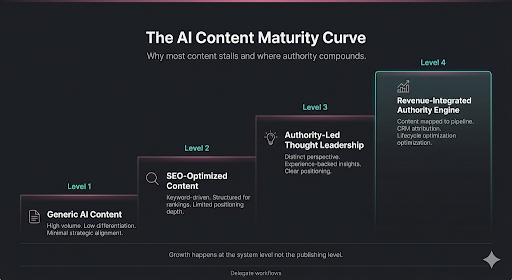
In 2026, authority depends on system design, not writing ability alone.
3. The Decline of Passive Organic Reach
Organic visibility has tightened across platforms. Publishing without a distribution strategy often results in content that is technically ‘live’ but practically invisible.
Additionally, aged content that is not updated gradually loses ranking strength. Without structured lifecycle maintenance, even strong posts decay.
Publishing creates visibility. Maintenance and distribution create authority.
What Professional Blog Management Actually Covers
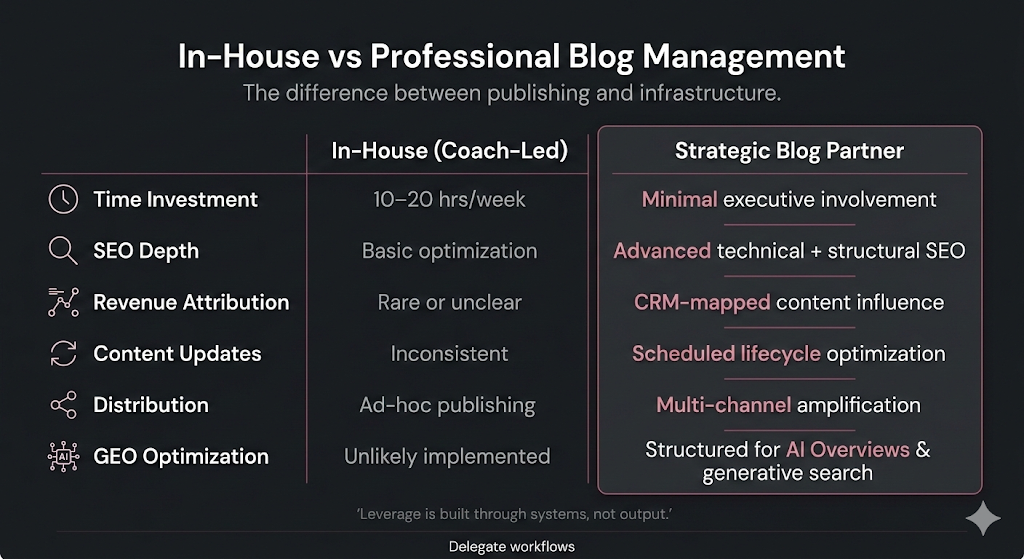
Think of professional blog management less as writing support and more as systems architecture.
Strategic Alignment to Revenue
According to recent marketing benchmarks, 71% of successful content marketers operate from a documented strategy. Yet many coaches publish reactively.
A strategic partner builds:
- Topic-to-offer mapping
- Lead magnet integration
- Funnel-stage alignment
- CRM tracking for content-influenced leads
Traffic is measured. But pipeline contribution matters more.
If content is not mapped to revenue, it remains a branding asset, not a growth engine.
AI-Human Authority Blending
Effective partners leverage AI for:
- SERP gap analysis
- Outline structuring
- Research acceleration
Human expertise then shapes:
- Executive-level insight
- Positioning nuance
- Case study framing
- Authority-building narrative
This hybrid model preserves credibility while improving efficiency.
Lifecycle Optimization & Authority Maintenance
Most in-house blogs publish and move on.
Professional management includes:
- Auditing aging posts
- Updating statistics and insights
- Consolidating competing URLs
- Internal linking architecture
- Schema implementation
- Structuring for AI Overview extraction
Search engines reward freshness, clarity, and structural integrity.
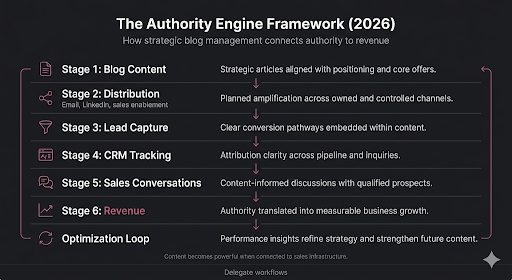
In-House vs. Professional Blog Management
The difference isn’t writing quality. It’s strategic infrastructure.
The 5-Point Checklist for Choosing a Blog Management Partner
1. Revenue Attribution Capability
- Can they demonstrate content-to-CRM mapping?
- Can they show which posts influenced the pipeline?
If they can’t connect content to conversations, they’re producing output, not outcomes.
2. Documented Strategic Framework
Ask to see their editorial roadmap, funnel alignment methodology, and KPI dashboards. Generic promises aren’t enough.
71% of high-performing content teams operate from documented plans, and your partner should too.
3. Distribution beyond the blog
Content that only lives on your website is underperforming.
Strong partners extend every post to email, LinkedIn, and sales enablement assets. If they only publish, they’re only doing half the job.
Authority amplification across LinkedIn and owned media channels compounds visibility.
4. Data Governance & quality control.
36% of marketers report struggles with data quality and compliance.
A serious partner ensures clean tracking, proper attribution, and oversight, so your data is actually usable.
5. Generative Search Optimization (GEO)
Ask directly:
- How do you structure content for AI Overviews?
- Do you create modular, answer-ready sections?
- Do you use schema and structured formatting?
If they can’t answer this, they’re building for 2020, not 2026.
If they cannot clearly explain these systems, they are providing ghostwriting services, not growth architecture.
Red Flags Executive Coaches Should Avoid
As important as knowing what to look for is recognizing the warning signs that a partnership will underdeliver:
- Volume first promises: Any emphasis on post count or word count without a discussion of your business goals
- Vanity metric reporting: Updates focused on likes, shares, and pageviews rather than pipeline contribution
- No content update process: a workflow that creates but never maintains your existing content library
- No integration with sales data: A partner who does not ask for access to your CRM or client feedback cannot produce content that moves prospects through your funnel
- No buyer journey mapping: Editorial plans disconnected from how your ideal clients actually make decisions.
When Is It Time to Outsource Blog Management?
The decision to bring in a professional blog management partner is a strategic one.
Consider it seriously if any of the following conditions describe your current situation:
- You publish consistently, but inbound leads remain flat.
- You cannot identify which posts influence sales conversations.
- Your messaging feels interchangeable with competitors.
- You lack a documented content-to-revenue framework.
- You are spending 10 or more hours per week on content tasks that pull you away from billable work
If two or more of these describe your situation, you are not managing a content strategy; you are managing a content burden.
Our strategic blog management framework is built around this system’s architecture.
From Blog Posts to Authority Engine
Executive coaches operate at a level of leverage most professionals never reach.
They transform how leaders think, how organizations perform, and how individuals navigate the most consequential moments of their careers. Their content infrastructure should reflect that level of impact.
A well-managed blog is not a marketing expense. It is a compounding asset, one that builds authority over time, attracts the right clients, and creates a body of work that opens doors long after a single post is published. But that only happens when the infrastructure is designed for it.
The question is not whether to invest in your content. It is whether the system behind your content is built to convert.
Blog Management as an Infrastructure
High-ticket coaching depends on trust built before the first conversation.
Your blog is often the first extended interaction a prospective client has with your thinking.
At the level you operate, content isn’t meant to “stay active.” It’s meant to reinforce positioning, filter serious prospects, and reduce friction in high-value sales conversations.
If it feels intentional, precise, and aligned, it builds authority before you ever enter the room.
When that alignment is missing, blogs become maintenance tasks. When that alignment is built intentionally, blogs become leverage.
The difference is architecture.
And architecture requires deliberate design.
For coaches charging premium retainers, content should work as quietly and consistently as any other core business system.
If it doesn’t, the next step isn’t more publishing. It’s clarity.
Request a Strategic Content Audit
Clarity before scale. Infrastructure before publishing.
If your blog is active but not influencing pipeline, positioning, or revenue, the issue isn’t consistency. It’s alignment.
A strategic audit evaluates:
- Content-to-offer alignment
• Buyer journey mapping
• CRM attribution clarity
• Lifecycle optimization gaps
• Generative search readiness
This is not a surface-level review.
It is a systems-level assessment designed for high-ticket executive coaches operating at a premium level.
If your content is meant to support authority, it should function like one of your core business systems.
Designed for executive coaches who expect measurable impact from their marketing infrastructure.
Pingback: Why Boring Content Wins in B2B Content Strategy 2026
Pingback: 5 Signs You’ve Outgrown Your VA (And When to Stop Relying on One)