
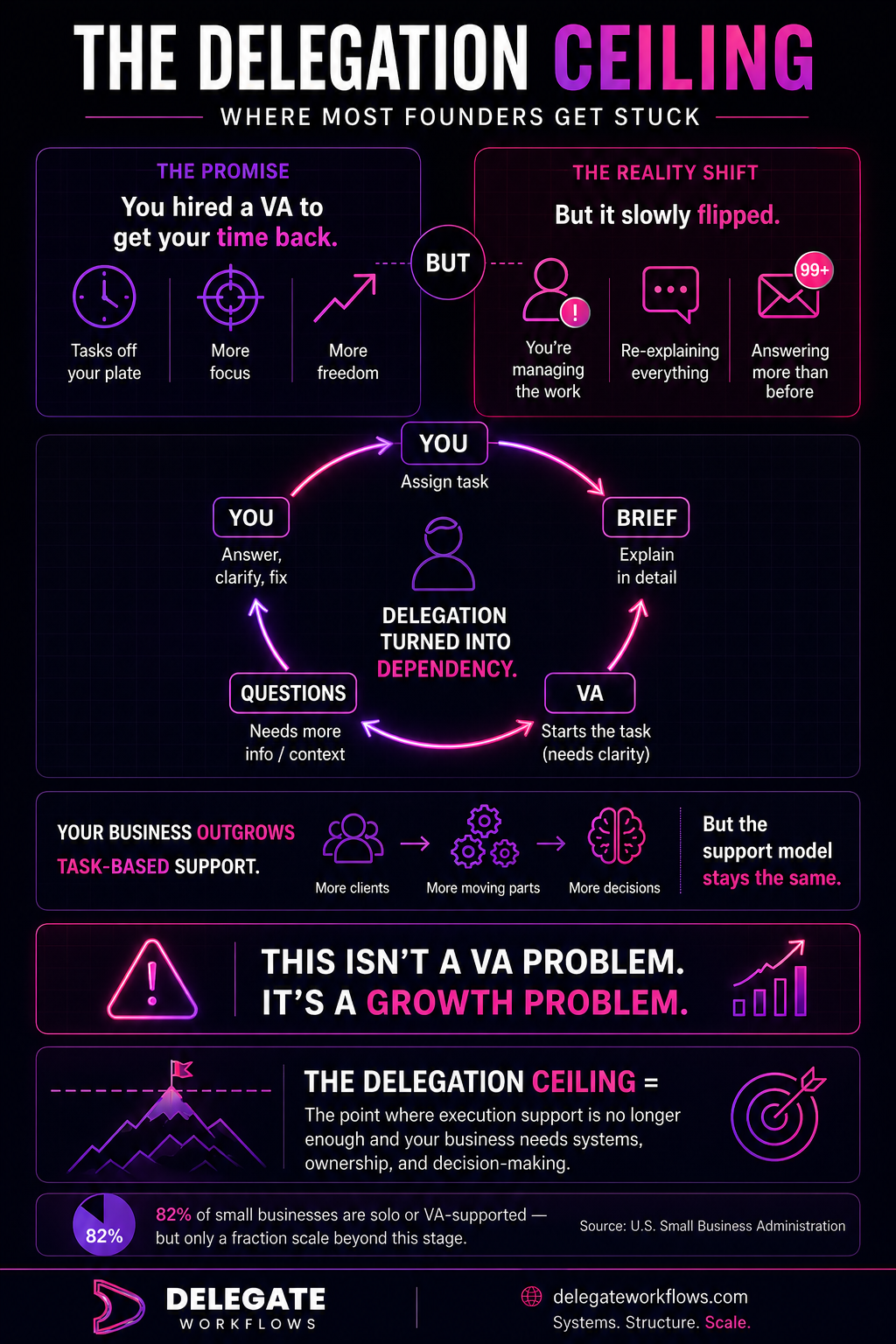
You hired a virtual assistant to get your time back.
But somewhere along the way, you became the person managing the person who was supposed to manage your tasks. You’re answering more messages, re-explaining the same things, and somehow working harder than before they joined.
This isn’t a VA problem but a growth problem.
There’s a ceiling every scaling founder eventually hits, and a virtual assistant, no matter how talented, is not built to push through it with you. This blog will help you identify exactly where that ceiling is, and what to build above it.
Why the VA Model Eventually Stops Working
Virtual assistants are built for execution. They are exceptional at taking a defined task off your plate and completing it. That’s the model, and for early-stage founders, it works beautifully.
But as your business grows, so does its complexity. You’re no longer dealing with a task list. You’re dealing with systems, decisions, client relationships, team coordination, and operational gaps that shift week to week.
That’s not a job for a task-doer. That’s a job for a systems-thinker.
According to the U.S. Small Business Administration, 82% of all small businesses in the US are solo or VA-supported, yet only a fraction ever scale past this stage. The VA plateau is one of the most common and least talked about ceilings in business growth.
So how do you know you’ve hit it?
5 Signs You’ve Outgrown Your VA
1. You’re Spending More Time Briefing Than Doing
If walking your VA through a task takes longer than it would have taken you to do it yourself, that’s not a time-saving system. That’s a complex problem.
It doesn’t mean your VA is bad at their job. It means the job has outgrown the role. When every assignment requires a 5-minute voice note, a Loom video, and three follow-up messages, your business is signalling that it needs someone who can think ahead, not just follow behind.
2. Your VA is Constantly Waiting on You
Pay attention to who’s always waiting on who. If your VA can’t move without your direct input, you haven’t actually delegated work; you’ve just added an extra step to your own process.
A well-structured support system runs when you’re not watching. If your VA is stuck every time you’re in a meeting, on a call, or offline for a day, your business doesn’t have delegation. It has a dependency.
3. Important Things Are Falling Through the Cracks
Missed follow-ups. Delayed deliverables. Client details that nobody tracked. Deadlines that somehow slipped.
These are signals that your business has grown beyond what a single execution-focused role can manage, not failures. What you need now isn’t someone to do more tasks. You need someone to own the system that makes sure nothing falls through, ever.
4. You’re Still the One Building and Fixing Processes
A virtual assistant runs SOPs. If you’re still writing them, revising them, and fixing broken workflows yourself, you’re doing operations management on top of everything else.
That is not what founders who scale do. If your business relies on you to design how work gets done, not just approve that it’s done, you’ve crossed into a different category of need entirely.
5. Your Revenue Has Grown, But Your Bandwidth Hasn’t
This is the clearest sign of all. Your client list is longer. Your offers have expanded. Your revenue is climbing. And yet you feel more stretched, more reactive, and more exhausted than when you had fewer clients.
Growth without capacity is just pressure by another name. According to research, team structure issues contribute to 23% of startup failures. Getting the support layer wrong as you scale isn’t a minor inconvenience; it’s a risk to the business itself.
The 3-Question Delegation Audit
Before you make any hiring decisions, run through these three questions honestly:
- Can your business run for 48 hours without your direct input? Not perfectly, but functionally. Can work continue, clients get responses, and deliverables move forward without you touching everything?
- Are you making strategic decisions daily or managing task lists? Founders who are scaling should be thinking about growth, not chasing updates. If your daily energy is going into task coordination, your support structure is too thin.
- Is your support system solving problems or just completing them? There’s a difference between someone who finishes a task and someone who notices a gap and addresses it. Which one do you have?
If you answered “no” to all three, you don’t just need more help. You need a different kind of help.
Not sure what that looks like for your business specifically?Book a free Delegation Audit at Delegate Workflows We’ll map exactly where your bottlenecks are and tell you what to build next.
So What Comes After a VA?
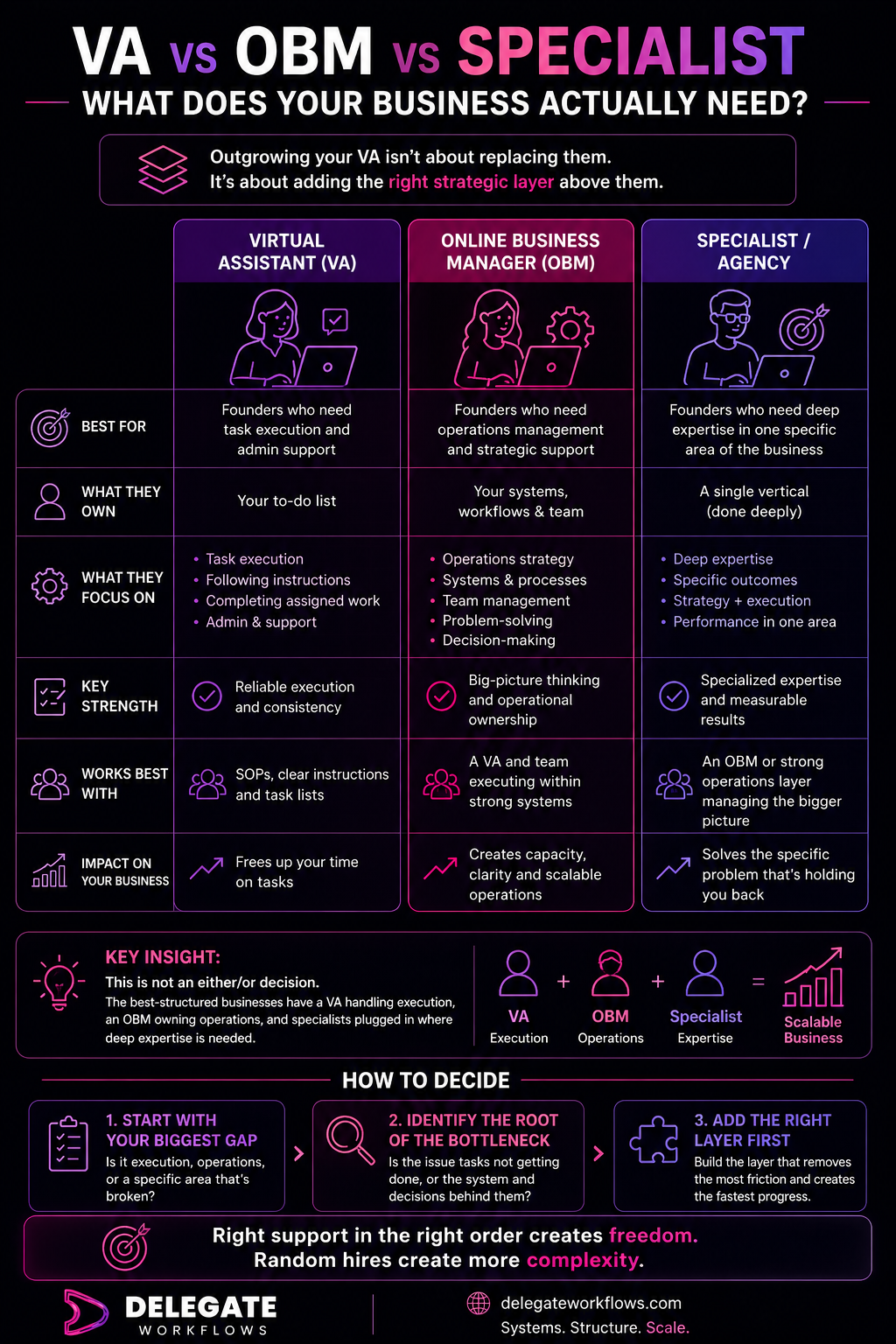
Outgrowing your VA doesn’t mean replacing them. It means adding a strategic layer above them, someone who can own operations, manage complexity, and make decisions without you in every loop.
Here’s a comparison of the three main options:
(For full cost comparisons, see this 2026 virtual assistant pricing breakdown)
Founders who’ve outgrown their VA need an OBM, someone who can think strategically about how the business runs, not just what gets done inside it. Some need a specialist to take ownership of one broken area (marketing, finance, client delivery) before anything else can work.
The biggest mistake founders make at this stage is hiring reactively, bringing someone new in without a handover plan and expecting the chaos to sort itself out.
It doesn’t. Here’s how to do it properly:
Step 1: Run a task audit. For one week, track everything your VA does. What’s execution-only? What requires judgment? What is currently falling on you that shouldn’t be?
Step 2: Separate execution from decision-making. Anything that requires context, judgment, or problem-solving is not a VA task. That’s your gap. That’s what you need to hire for next.
Step 3: Hire for the judgment layer first. Bring in your OBM or specialist before you feel desperate. Hiring from a place of crisis always costs more in time, money, and energy.
Step 4: Hand off SOPs cleanly. Your VA doesn’t disappear in this transition; they become more effective because someone else is managing the system they work within. Document what exists, hand it to your new hire, and let them build from there.
The Bottom Line
Outgrowing your VA is not a failure. It is proof that your business is working.
Scaling founders aren’t defined by hiring better VAs, but by knowing when the model no longer works and restructuring before it breaks.
If you’re nodding along to these signs, trust that recognition. Your instinct is right. The next layer exists. You just need a clear plan to build it.
Start with a free Delegation Audit → delegateworkflows.com
We’ll show you exactly what your business needs next and how to get there without burning out in the process.
What is the difference between a VA and an OBM?
A virtual assistant handles task execution, completing specific work you assign to them. An Online Business Manager (OBM) owns your operations. They manage systems, workflows, and often people, thinking strategically about how your business runs, not just what gets done inside it.
If you want to go deeper on how delegation frameworks work at an operational level, this is a strong resource.
When should I stop using a virtual assistant?
You haven't necessarily outgrown your VA when you're still a solopreneur. The signs you've outgrown your VA appear when your business complexity exceeds your assistant's strategic capacity, typically when you're spending more time managing the VA than growing the business, or when critical things are consistently falling through the cracks.
Can I keep my VA and hire an OBM?
Yes, and in most cases, this is the right move. Your VA continues handling execution. Your OBM manages the systems and team that your VA works within. The two roles complement each other. The OBM essentially becomes the person your VA reports to, freeing you from day-to-day task management entirely.
How do I know if I need a specialist instead of an OBM?
If one specific function in your business is clearly broken, marketing isn't converting, finances are unclear, or client delivery is inconsistent, a specialist or agency may be the priority over an OBM. Fix the broken vertical first, then build the operational layer around it.