
In short:
For B2B founders scaling from $0 to $1M ARR, a virtual assistant preserves agility and protects cash flow. A full-time hire makes sense only when a role demands 40+ hours of strategic, institutional decision-making every week and your revenue can sustain it without burning your runway.
You are doing the work of four people.
Scheduling. Prospecting. Following up on proposals. Managing inboxes. Writing content. Jumping on calls. And somewhere in between all of that, trying to actually grow your business.
According to the SBA 2025 Small Business Profile, there are 36.2 million small businesses in the United States. A staggering 82% of them operate without a single full-time employee, founders running lean, wearing every hat, and quietly burning out.
You don’t have to question whether you need help or not. You do. But the real question is, what kind of help actually makes financial sense right now?
This post breaks down the economics, the decision framework, and the operational logic behind choosing between a virtual assistant (VA) and a full-time hire, so you stop guessing and start deciding with data.
The 2026 Founder Reality
Before comparing costs, let’s talk about the problem.
Research from 2026 shows that B2B founders and sales reps spend up to 60% of their working hours on administrative tasks, not strategy, not selling, not building.
That’s three out of every five hours gone to emails, scheduling, data entry, follow-ups, and internal coordination.
If you’re billing at even $150/hour, that’s $450 lost per day to tasks that don’t require your expertise. Tasks that can be delegated.
This is the core operational problem that both a VA and a full-time hire are meant to solve, but they solve it very differently, at very different price points.
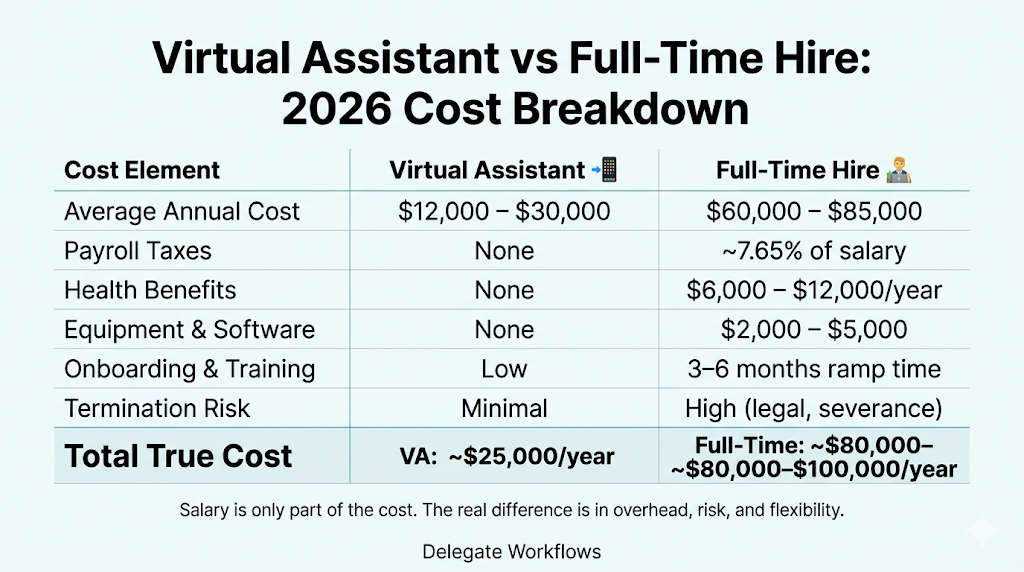
A full-time hire at a $65,000 salary can easily cost you $85,000 to $100,000 annually once you factor in taxes, benefits, tools, and ramp time.
A skilled VA, working 20 hours per week at $25/hour, costs approximately $26,000 per year with zero overhead, zero benefits liability, and the flexibility to scale hours up or down based on your workload.
When a VA Is the Smarter Move
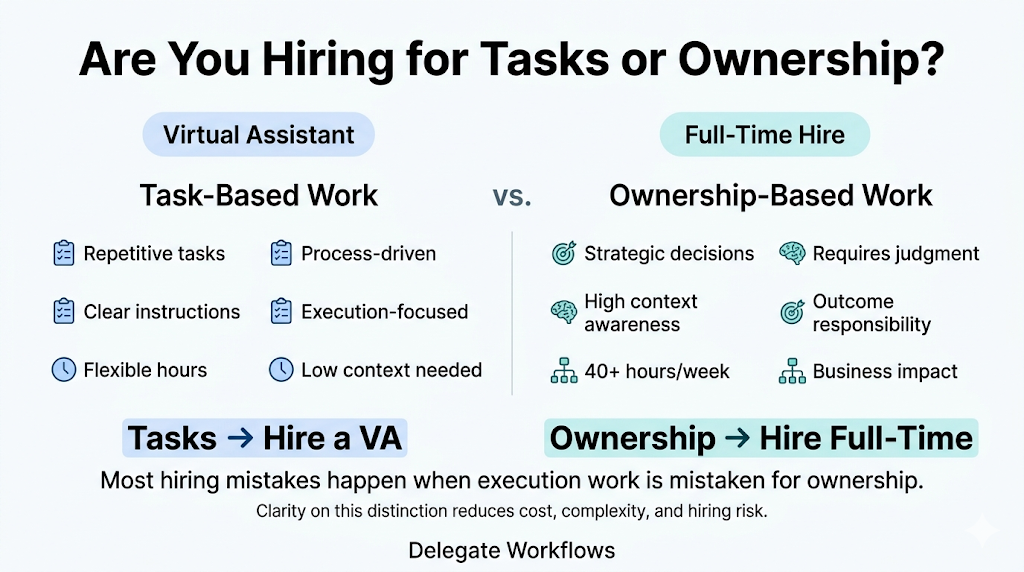
A virtual assistant is the right choice when the work is recurring, systemizable, and doesn’t require institutional authority.
Choose a VA when:
- You need consistent execution on defined tasks (inbox management, scheduling, CRM updates, research, content formatting, social scheduling)
- Your revenue doesn’t yet justify a fixed $80K+ annual overhead
- You need flexibility, scaling hours up during launches, down during slow months
- You want to test a role before committing to a full-time position
- You’re in the $0 to $1M ARR stage, and protecting burn rate is non-negotiable
Here’s the strategic upside founders often miss: a VA frees you to focus on the 40% of your work that only you can do, the high-leverage sales conversations, partnership decisions, and product direction that actually move the revenue needle.
At Delegate Workflows, we’ve seen founders reclaim 15 to 20 hours per week simply by building a clean delegation system around a VA. That’s not just time saved, that’s a second sales cycle per week recovered.
When a Full-Time Hire Makes Sense
A full-time employee earns their cost when the role requires deep judgment, company-wide context, and cannot be systematized.
Choose a full-time hire when:
- A role requires 40+ hours per week of strategic decision-making
- The function holds institutional knowledge your business can’t afford to lose (e.g., a Head of Operations, a senior engineer, a client success lead)
- You’ve crossed $1M ARR, and the role is directly tied to retaining or expanding revenue
- The work requires legal employment status (HR, finance, compliance)
- Culture and team cohesion depend on someone being embedded full-time
The Hybrid Model: What Smart B2B Founders Are Doing in 2026
Many founders aren’t choosing between a VA and a full-time hire. They’re building a layered delegation model.
With 46% of North American startup funding in 2025 going to AI-related B2B companies, founders are pairing VAs with agentic AI tools, automating the repeatable, delegating the executable, and reserving full-time headcount only for roles that require human judgment at scale.
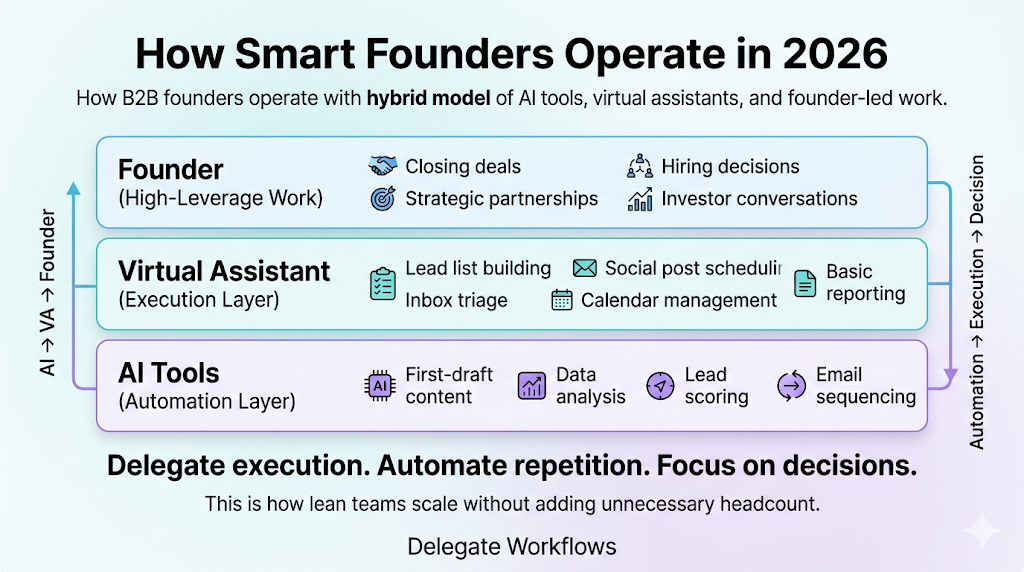
This model lets you operate like a 10-person team on a 2-person budget, which is exactly the kind of lean efficiency that keeps your LTV*:CAC* ratio healthy while you scale.
LTV*- Customer Life Time Value
CAC*- Customer Acquisition Cost
A Simple Decision Framework for Founders
Still unsure? Run this quick mental audit:
Step 1 – List every task you do in a week.
Step 2 – Mark which ones require your unique expertise or authority.
Step 3 – The unmarked tasks are your delegation list.
Step 4 – If the delegation list adds up to 20+ hours/week, start with a VA.
Step 5 – If one specific function needs 40+ strategic hours and revenue supports it, consider a full-time hire.
Most founders who do this exercise discover they’re doing $25/hour work at $150/hour rates. The math fixes itself once you see it clearly.
Build the System Before You Build the Team
In 2026, the founders winning aren’t the ones with the biggest teams. They’re the ones with the clearest delegation systems.
With approximately 535,000 new business applications filed in November 2025 alone, competition for attention and clients is only getting fiercer. You cannot afford to spend 60% of your day on administrative tasks and expect to outpace founders who’ve already built lean, delegated operations.
Start with a VA. Build the system. Protect your time. And when revenue and role complexity demand it, make the full-time hire with confidence, not desperation.
Ready to build a delegation system that actually works? At Delegate Workflows, we help B2B founders design the exact workflows that make VA delegation seamless, so you stop losing hours and start scaling intentionally.
Is a virtual assistant cheaper than hiring a full-time employee?
Yes, significantly. A full-time hire in 2026 costs $80,000–$100,000 per year when factoring in salary, benefits, taxes, and tools. A skilled VA typically costs $12,000–$30,000 annually with no overhead.
When should a B2B founder hire a full-time employee instead of a VA?
When the role requires 40+ hours of strategic decision-making per week, holds institutional knowledge, or is directly tied to retaining revenue at the $1M+ ARR stage.
Can a VA handle B2B sales tasks?
Yes, VAs can handle lead research, CRM updates, follow-up sequences, and outreach scheduling. The high-value sales conversations and closing still require the founder or a dedicated sales hire.
What is the hybrid VA + AI model?
It's a delegation framework where AI tools handle automation (content drafts, data analysis, email sequencing) and a VA handles execution tasks (scheduling, inbox, research), freeing the founder for high-leverage work only they can do.
How do I know if I'm ready to delegate?
If you're spending more than 3 hours per day on tasks that don't require your direct expertise, you're ready. Start by listing every repeatable task in your week; that's your first delegation brief.
Pingback: The Real Cost of Hiring a Virtual Assistant (Why $5/Hour VAs Cost You More)
Pingback: 5 Signs You’ve Outgrown Your VA (And When to Stop Relying on One)