
You hired a VA to get time back.
But somehow, you’re still the one explaining every task, redoing half the work, and managing someone who was supposed to manage things for you.
Sound familiar?
The problem usually isn’t the VA. It’s the type of VA you hired.
Most founders choose based on price and end up paying far more in time, frustration, and stalled momentum. This guide gives you a decision framework, not just a comparison, so your next hire actually moves your business forward.
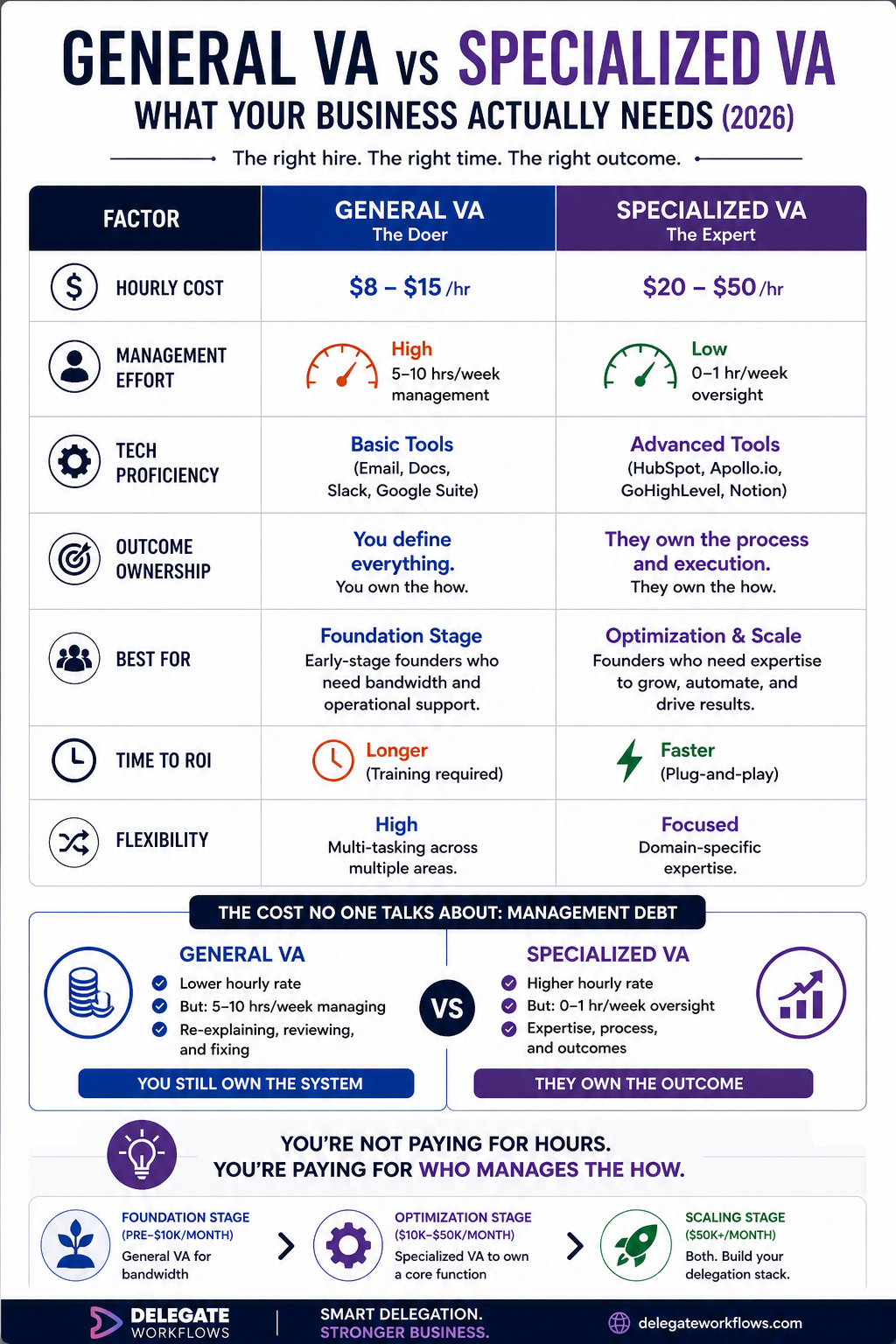
The difference between a general VA and a specialized VA isn't just about tasks; it's about who owns the "how." A general VA executes what you define. A specialized VA brings the expertise, the process, and the outcome. Choosing wrong doesn't just cost money; it costs the one thing you can't buy back: momentum.
Table of Contents
What Is a General Virtual Assistant?
A general virtual assistant is a multi-tasker. They handle the administrative layer of your business, the repetitive, process-driven work that keeps things running but doesn’t require deep domain expertise.
Typical tasks include:
- Inbox and calendar management
- Data entry and CRM updates
- Travel and meeting coordination
- Basic customer support
- Scheduling social media posts (not strategy, just execution)
Their biggest strength is flexibility and volume. They can handle a wide range of tasks as long as you define the system. They’re best suited for founders in the early stage of building, when you need bandwidth, not brilliance.
What Is a Specialized Virtual Assistant?
A specialized VA operates in one domain and owns it completely.
They don’t wait for you to explain the process. They bring the process, the tools, and the expertise to deliver outcomes in their area of focus.
Common specializations include:
- LinkedIn VA – content scheduling, engagement strategy, Sales Navigator outreach
- CRM VA – HubSpot workflows, Apollo.io sequences, GoHighLevel automation
- Content VA – long-form writing, SEO optimization, content repurposing
- Paid Ads VA – Meta or Google campaign management, A/B testing, reporting
- Operations VA – SOP creation, Notion/ClickUp systems, team coordination
Their biggest strength is depth and outcome ownership. You hand them a function they run it. They’re best suited for founders who already know what needs to happen but don’t have the bandwidth or expertise to execute it themselves.
The Real Difference: Management Debt
Here’s what no one talks about and what most founders learn the hard way.
A general VA looks cheaper on paper. But “cheaper per hour” is a trap.
When you hire a general VA, you take on what we call Management Debt, the invisible hours you spend training them, answering questions, reviewing their work, and re-explaining processes. That cost doesn’t show up on the invoice. But it shows up in your calendar.
A realistic comparison:
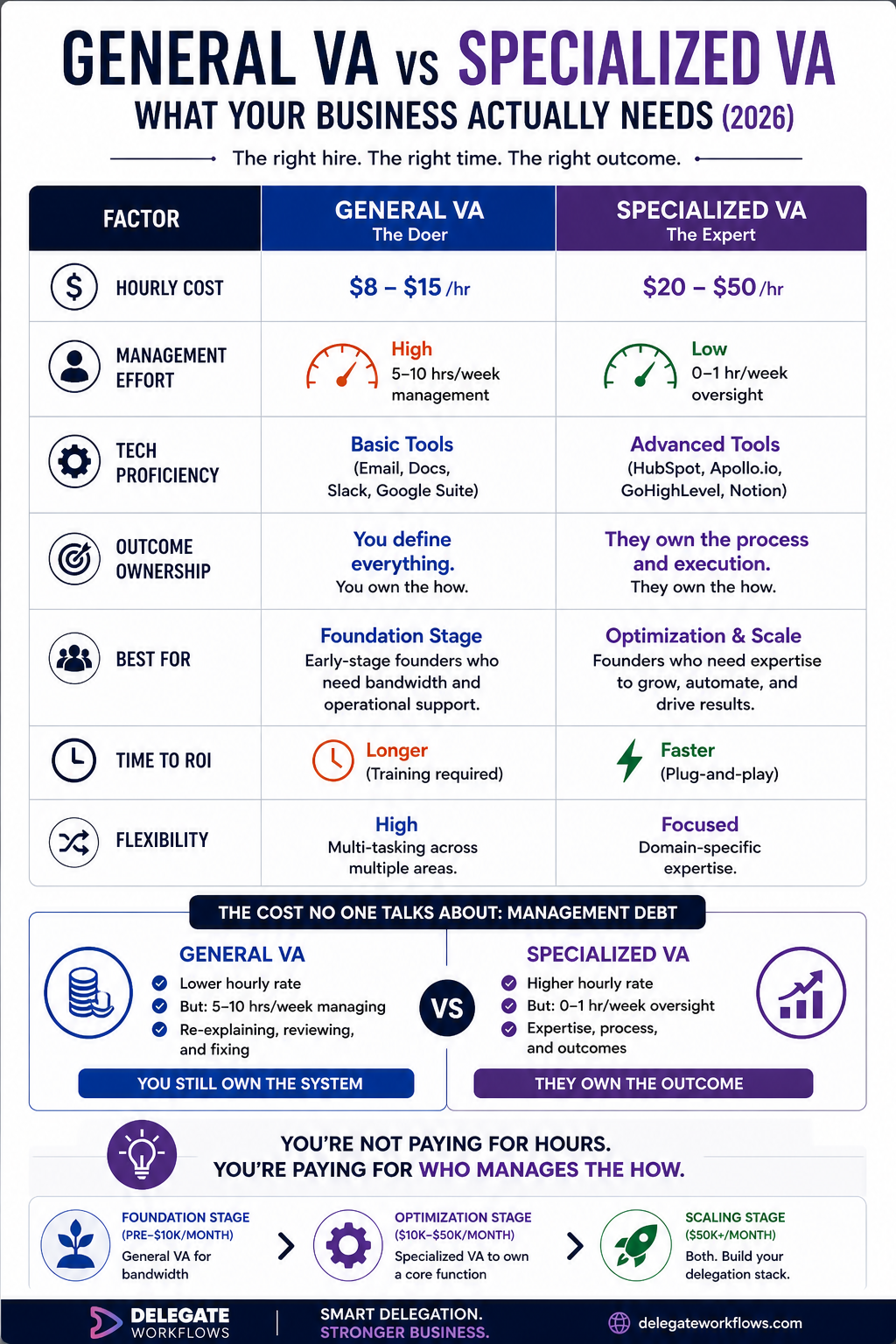
When you factor in the cost of your time, a specialized VA often delivers a better ROI, not despite the higher rate, but because of the lower management overhead.
You’re not just paying for hours. You’re paying for who manages the how.
Where Is Your Business Right Now? The Growth Stage Framework
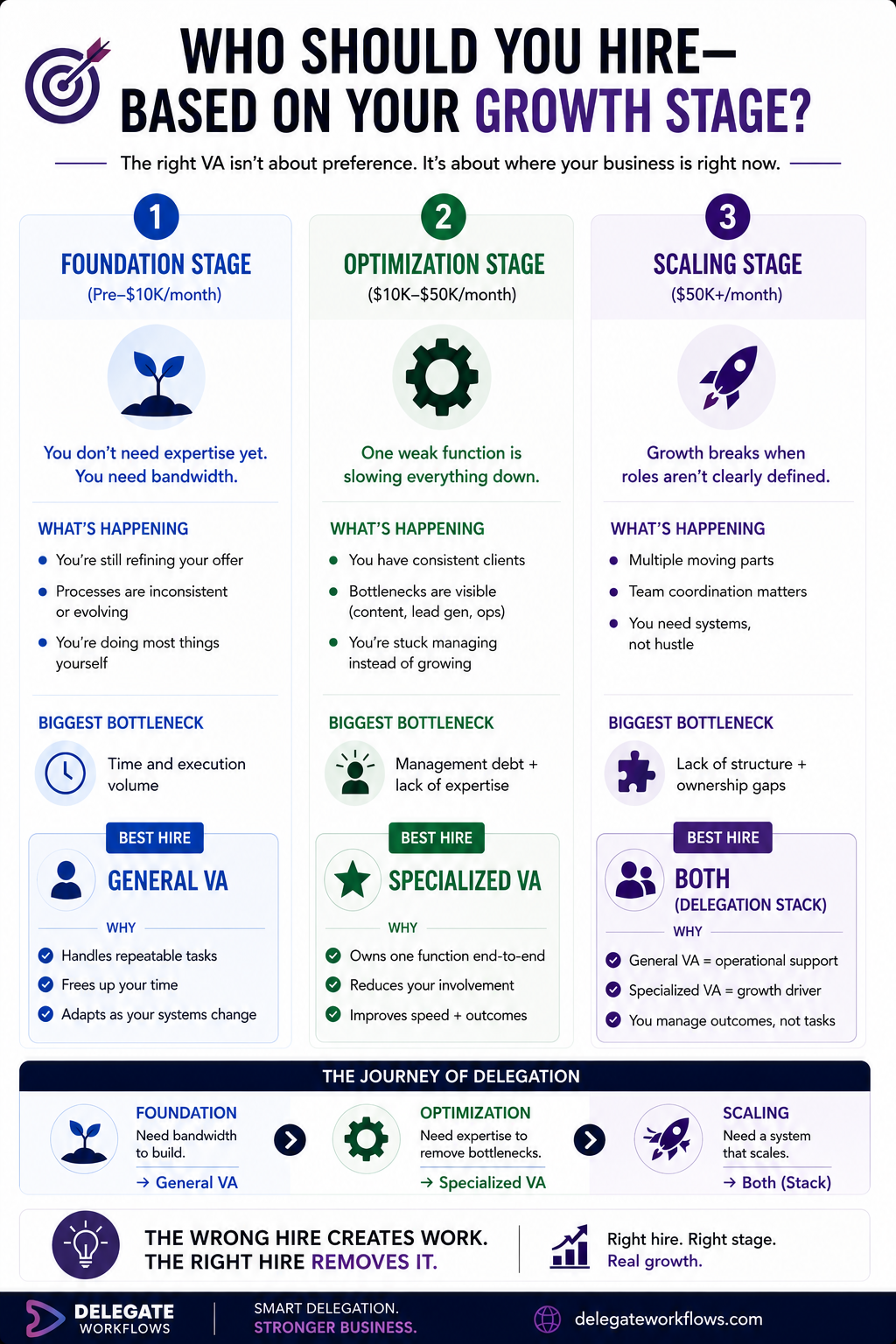
The right VA is about stage but preference. Here’s how to match your hire to your current reality.
The Foundation Stage (Pre-$10K/month)
You’re still refining your offer, building your first systems, and doing most things yourself. Your biggest need is bandwidth, someone to handle the volume so you can focus on client delivery and revenue.
→ A general VA wins here. The tasks are repeatable, the stakes are lower, and the training investment is worth it when your processes are still evolving.
The Optimization Stage ($10K–$50K/month)
You’ve got traction. Clients are coming in, but bottlenecks are forming. One function, lead generation, content, and ops is dragging everything else down.
→ A specialized VA wins here. You need someone who can own a function end-to-end, not someone you need to hand-hold. This is where management debt becomes the real cost.
The Scaling Stage ($50K+/month)
You need both. A general VA handles the operational layer. A specialized VA drives a core growth function, whether that’s your LinkedIn pipeline, your CRM nurture, or your content engine.
This is the Delegation Stack model, where each hire has a defined lane, and you’re managing outcomes, not tasks.
Hire a General VA If…
- Your monthly budget for VA support is under $1,500
- Your tasks are repetitive, well-documented, and process-driven
- You have time to create SOPs and train someone from scratch
- You’re still pre-product-market fit, and your systems are changing frequently
- You need volume support across multiple areas, not depth in one
Hire a Specialized VA If…
- Your bottleneck is a specific function, lead gen, content, CRM or ads
- You can’t afford to lose 5–10 hours a week on training and oversight
- Your B2B sales cycle is 90+ days and needs expert nurturing (not just task execution)
- You’re ready to delegate outcomes, not just tasks
- You’ve already tried a general VA and outgrown them
The Decision Matrix
A Quick Note for B2B Founders Specifically
If you’re running a B2B business, the stakes of this decision are higher than you might think.
According to Gartner’s 2026 data, the average B2B sales cycle now runs 121 days for mid-market deals and 218 days for enterprise. The average buying committee has grown to 11.2 stakeholders, each requiring tailored touchpoints, nurturing sequences, and content that speaks to their specific role.
A general VA cannot manage that complexity. They can book meetings and send follow-up emails.
But building and executing a 90-day LinkedIn nurture sequence for 11 stakeholders across three accounts? That’s specialized work.
B2B founders who try to stretch a general VA into specialized functions almost always end up with one result: the founder stepping back in to fix it themselves.
If your revenue model depends on long sales cycles and relationship-driven deals, your VA hire needs to match that complexity.
The wrong VA hire doesn’t just cost money; it costs momentum. And momentum, at the stage most founders are in, is the most expensive thing to lose.
Here’s the framework, simplified:
- Foundation Stage → General VA for bandwidth
- Optimization Stage → Specialized VA to own a function
- Scaling Stage → Both, in a delegation stack
Ask: “What does my business stage actually need right now?”
Answer that honestly, and the hire becomes obvious.
Not sure which VA type fits your current stage? Take our delegation audit and get a clear picture of where to delegate first and who should own it.
Already know you need systems behind your delegation? Explore our workflow frameworks built for scaling founders.
Can a general VA become a specialized VA?
Yes, but the transition takes 3–6 months of focused upskilling. If your bottleneck exists right now, you can't wait for a generalist to grow into a specialist. Hire for the problem you have today.
Can I hire both a general and specialized VA at the same time?
Absolutely, and for most businesses past $10K/month, this is the right move. Your general VA handles operational volume; your specialist owns one high-leverage function. This is the delegation stack model.
How do I know I'm ready for a specialized VA?
Simple test: if you've explained the same process to your current VA more than twice, you need a specialist. Repetition is the clearest sign that your bottleneck has outgrown a generalist's skill set.
What if I can't afford a specialized VA yet?
Start with a general VA, but build your systems as if you'll hand them to a specialist. Document your processes, define your outcomes, and when you're ready to upgrade, the transition will be seamless.